Get Full Government Meeting Transcripts, Videos, & Alerts Forever!
Get email alerts on the Energy Procurement topic
No spam. Unsubscribe anytime.
CleanPowerSF RFP issued; SFPUC limits REC use and shortens minimum contract term
Summary
The SFPUC published the Community Choice Aggregation RFP (CleanPowerSF) on Aug. 5; staff limited renewable energy credit (REC) use to half the gap between state RPS and the local 51% goal, tied oral interview scoring to written criteria, shortened minimum contract terms to three years, and set proposer deadlines for mid-September and early October.
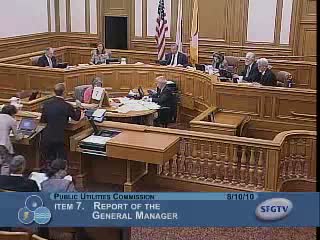
Mike Campbell, director of the Community Choice Aggregation program, told the commission that the CleanPowerSF supply RFP was issued Aug. 5 and that staff incorporated commissioner and LAFCO feedback to make the document clearer and more evaluation criteria explicit.
Campbell described several substantive edits: oral interview scoring will be directly tied to the same written evaluation areas; renewables procurement rules were adjusted to limit suppliers’ use of renewable energy credits (RECs) to half the difference between the state RPS baseline (20 percent) and the program goal (51 percent), effectively capping REC‑sourced energy at roughly 15.5 percent of the portfolio; proposals that rely more heavily on RECs will score lower than those with less REC use. Staff also reduced the RFP minimum contract term from five years to three years to allow proposers flexibility and better align with potential RFO outcomes for new generation development.
Campbell emphasized energy efficiency and demand response as integral parts of the portfolio and said the RFP expects proposers to describe what constitutes project success and expected opt‑out rates. The procurement schedule calls for proposer questions by Sept. 15 and submissions by Oct. 6, with short‑listing in October and November and negotiations aiming to conclude in December with the goal of serving customers in February.
During public comment, stakeholders raised process concerns: coalition representatives urged that the procurement and RFO processes be kept as a single integrated package (renewables, efficiency and demand response) to preserve economies of scale; staff said the RFO process will be used in addition to the RFP to solicit development ideas and that bidders may form consortia to meet the program’s range of requirements.
Ending: The RFP moves forward on the schedule described; staff will brief commissioners as proposals arrive and proceed with short‑listing. The commission did not take a separate vote on the RFP issuance at this meeting.