Get Full Government Meeting Transcripts, Videos, & Alerts Forever!
Get email alerts on the Hunters Point Redevelopment topic
No spam. Unsubscribe anytime.
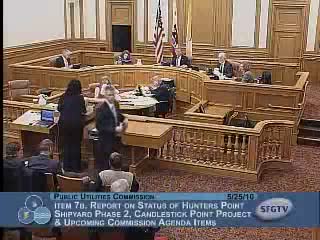
Developers, city staff outline 10,500-unit Hunters Point/Candlestick plan; residents and advocates warn of contamination risks
Summary
City staff and the redevelopment team presented a plan to redevelop Hunters Point Shipyard and Candlestick Point with 10,500 homes (32% below-market-rate), large parks and job commitments; public commenters and an environmental advocate urged caution about Superfund contamination, stormwater reuse and community benefits ahead of a June hearing.
San Francisco officials and redevelopment staff presented the conceptual framework for Phase 2 of the Hunters Point Shipyard and Candlestick Point redevelopment, describing a 700-acre mixed-use plan that calls for up to 10,500 housing units, parks, and job-generation measures.
Tiffany Bohe of the mayor’s Office of Economic and Workforce Development said the plan would deliver ‘‘hundreds of acres of open space, 10,500 new housing units, with 32% of those units set aside at below-market rates,’’ and highlighted a financing approach that relies on tax increment, Mello-Roos special taxes and private capital rather than the city general fund.
The presentation said the project includes a phased rebuild of the Alice Griffith public-housing site with ‘‘no public displacement’’ in early phases and expects ‘‘1,500 construction opportunities on an annualized basis’’ over buildout and more than 10,000 permanent jobs at full buildout. Mike Martin, development project manager, said the June 8 agenda will include an interagency cooperation agreement, related CEQA findings and acceptance of mitigation-monitoring responsibilities the PUC would oversee for utility infrastructure.
Public commenters and advocates urged greater detail on contamination, wastewater and stormwater treatment, and reuse standards. Francisco Acosta, director of environmental justice advocacy, said the site is ‘‘a Superfund site’’ and urged commissioners and staff to read the historical radiological assessment; he warned that homes built on contaminated parcels may carry restrictions and called for careful review of the EIR and regulatory records. Another commenter who sits on the Wastewater Citizens Advisory Committee said the stormwater plan appeared to ‘‘treat the stormwater and throw it away’’ and pressed for on-site reuse or graywater standards.
Bohe and Martin responded that the draft EIR and comments-and-responses had been circulated and that planning commissions will consider the EIR and implementation actions in early June; they noted the redevelopment program was designed to provide infrastructure, parks and affordable housing without exposing the city general fund to risk. The presenters said the redevelopment agency would enter a Disposition and Development Agreement (DDA) binding the developer to public-benefit obligations and that regulators such as the U.S. EPA and state agencies will certify transfers and remediation actions.
Next steps: commissioners were told the planning commission and redevelopment commission would act on related items on June 3 and that the PUC would see utility-related approvals on June 8. Staff invited commissioners to flag specific CEQA findings and stormwater/wastewater treatment details they want addressed in the June materials.
Why it matters: The project is one of the largest planned Bay Area infill developments; it links housing, jobs, parks and infrastructure in an area with an extensive remediation record. The commission must balance long-term infrastructure commitments with community health, remediation certification and enforceable obligations in the DDA and mitigation-monitoring program.