Get Full Government Meeting Transcripts, Videos, & Alerts Forever!
Get email alerts on the Discipline And Transparency topic
No spam. Unsubscribe anytime.
San Francisco Police Commission votes to move disciplinary cases into closed session after public comment on transparency
Summary
The Police Commission voted to hold disciplinary hearings in closed session after extensive public comment about case transparency and procedural changes; commissioners reiterated that disclosure decisions are controlled by the district attorney and the 2006 Copley decision limits what may be discussed publicly.
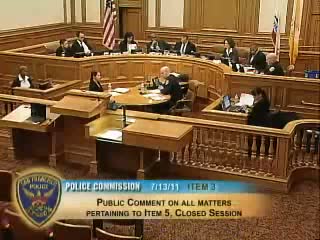
The San Francisco Police Commission voted July 13 to conduct disciplinary hearings in closed session for item 5, following public comments that pressed the panel on transparency around police misconduct cases.
Several residents used the public-comment period to raise concerns about police accountability and case disclosure. Dorothy Peterson of Hunters Point said she had been told an inspector intended to give her name "to the defense" despite her telling investigators she had not witnessed the killing she described. Barbara Grothe warned that the city attorney—s advice about the 2006 Copley decision could keep taxpayers from learning about alleged misconduct and serial promotions of officers.
Commissioners and the chief repeatedly stressed the limits of the commission—s authority. The chair and chief noted that disclosure of witness identities and investigatory records is, in many cases, a decision controlled by the district attorney—s office and shaped by the California Supreme Court—s Copley decision and the Police Officers— Bill of Rights. The chief told one resident the department would try to broker contact with the proper DA office representative through a named sergeant.
When the agenda reached Item 4 — a procedural vote on whether to hold Item 5 in closed session — a motion was moved and seconded and commissioners voted in favor. The chair then announced the meeting would recess to closed session for the disciplinary matters.
The vote and the earlier public comments underlined a tension that surfaced repeatedly in the meeting: members of the public pushing for more information about police misconduct cases and the commission—s limited ability to disclose those records because of legal constraints. Commissioners said they have discussed the transparency tradeoffs before and deferred legal discussion where required by existing case law and personnel privacy rules.
What happens next: the commission moved into closed session to conduct disciplinary hearings as announced on the agenda. The public portion of the meeting closed after the vote.