Get Full Government Meeting Transcripts, Videos, & Alerts Forever!
Get email alerts on the Wastewater Ssip topic
No spam. Unsubscribe anytime.
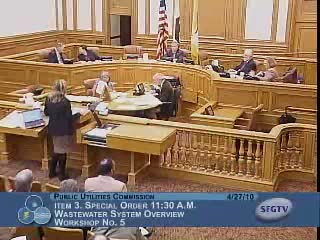
SFPUC presents SSIP workshop: LID, tunnel, biosolids and targets under scrutiny
Summary
At a April 27, 2010 workshop staff presented the fifth session on the Source System Improvement Program, recommending low-impact development, a Channel Tunnel, a Class A biosolids facility and expanded asset renewal while commissioners pressed for clearer quantification of targets, costs and rate impacts.
Karen Kubik, director of the wastewater capital improvement program, used the San Francisco Public Utilities Commission’s April 27 workshop to lay out proposed levels of service and a slate of projects for the Source System Improvement Program (SSIP).
Kubik told commissioners the program rests on eight goals including reducing pollutant loading to the Bay, minimizing flooding, improving environmental stewardship and building resilience for climate change. “We could reduce CSDs by a volume of a billion gallons,” she said, summarizing modeling that found long‑term low‑impact development (LID) could substantially cut combined sewer discharges and occurrences at public beaches.
The staff package pairs green interventions — downspout disconnection, Better Streets, vegetated swales and creek daylighting — with “gray” projects such as a proposed Channel Tunnel. Kubik said the tunnel alignment would run roughly from Mission Creek to Islas Creek, hold about 32,500,000 gallons and add roughly 26% to Bayside storage, improving seismic redundancy and reducing neighborhood flooding.
On biosolids, staff proposed a modern Class A digester facility with advanced odor control and energy recovery and identified two candidate sites: a south side expansion at the Southeast Plant and a Pier 94 backlands site under Port jurisdiction. Kubik said preliminary footprints range from about 8.9 to as much as 15 acres and that environmental review and Port approvals would be required.
Commissioners pressed for more specificity. Commissioner Moran asked whether the 35% and 20% figures shown in the presentation describe the LID contribution or the program-level LOS; Kubik replied that the percentages represent the modeled contribution from LID while the overall LOS could be higher when combined with other projects. Commissioners also asked for maps and cost/rate impact estimates to support future bonding and rate discussions.
Staff emphasized the program is iterative and multi‑decadal: some projects carry near‑term planning funding already approved for preliminary design and environmental work, while many outcomes — including siting, detailed alternatives, and funding packages — will be addressed in upcoming workshops and the environmental review phase.
The commission did not take policy-level votes on SSIP goals at the workshop; the presentation concluded with instructions to return in June with cost, schedule and implementation matrices so the board can “wrestle” with tradeoffs between green and gray alternatives and their rate impacts.