Get Full Government Meeting Transcripts, Videos, & Alerts Forever!
Get email alerts on the Climate Adaptation topic
No spam. Unsubscribe anytime.
San Francisco PUC convenes experts, plans citywide adaptation process for water and coastal infrastructure
Summary
At a Feb. 24 PUC workshop, local and national water experts warned of snowpack decline and sea level rise risks and outlined concrete steps — including a city‑led, multi‑department adaptation planning process and expanded utility collaboration — to protect water supply and shoreline infrastructure.
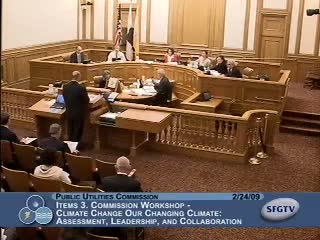
San Francisco — The San Francisco Public Utilities Commission convened scientists, regional regulators and utility leaders on Feb. 24 to examine how climate change could alter water supplies and threaten coastal and wastewater infrastructure, and to outline near‑term steps the city will take to adapt.
David Behar, the PUC’s climate lead, opened the workshop by saying that “water utilities are the first responders to the effects of climate change,” framing the session around two priorities: reducing greenhouse gases (mitigation) and adapting operations and infrastructure to rising seas and shifting runoff. Speakers warned that changes are already measurable and urged the city to move from planning to action.
Will Travis, executive director of the Bay Conservation and Development Commission, said historic records show Bay waters rose about 7 inches during the 20th century and presented scenarios in which the Bay could rise roughly one meter by the end of this century. He warned that “we can't wait a century to deal with this problem,” noting that low‑lying filled lands, San Francisco International Airport and wastewater facilities lie in the areas most exposed to inundation. Travis urged a mixed response of targeted levees, strategic retreat where appropriate and large‑scale tidal wetland restoration, which he said both reduces flood risk and sequesters carbon.
On the mountain watershed side, Margaret Hannaford, general manager of Hetch Hetchy Water and Power, described Hetch Hetchy basin modeling showing the snow line near 6,000 feet today and projected to rise by roughly 500 feet every 25 years in higher warming scenarios — causing the snow‑covered portion of the Hetch Hetchy basin to fall from roughly 85% today to about 75% by mid‑century. Hannaford said that modeled shifts would move peak runoff about a month earlier and shift roughly 7% of annual supply from spring into winter, and that staff are building daily operational models to test adaptive reservoir management.
Speakers from Seattle Public Utilities and the Pacific Institute said many adaptation measures can begin at low cost through operational changes and better regional science. Paul Fleming of Seattle described “Tier 1” operational adjustments — for example refilling or drawing down existing reservoirs differently — that can offset scenario losses without new dams, and he emphasized conservation's large payoff: Seattle projects historic conservation has saved tens of millions of gallons per day and continues to push more savings.
On mitigation, Wade Crowfoot from the mayor’s office reviewed the city's Climate Action Plan targets (a goal of 20% below 1990 emissions by 2012) and highlighted the city’s approach to scaling private financing tools, the local solar rebate program, the approved 5‑megawatt Sunset Reservoir power purchase agreement and pilot electric‑vehicle charging outside City Hall as examples of using municipal authority to leverage private capital and reduce emissions.
Several speakers described the Water Utility Climate Alliance (WUCA), a coalition launched after a 2007 utility summit to coordinate research, share operational lessons and commission national‑scale studies on downscaling climate models and decision‑support tools for utilities.
Commissioners asked about equity and process: how to define areas to protect with levees versus areas better suited to managed retreat, how to engage affected communities, and how to incorporate climate risks into the wastewater master plan and capital programming. City and PUC staff said they will convene a multi‑department adaptation planning process in the coming weeks to months, secure consultants to provide tailored data, and form a scientific advisory panel to review assumptions and modeling.
Public commenters urged immediate tactical work: one resident highlighted flooding and stormwater opportunities along the Mission Bay/Mission Creek corridor and asked the PUC to coordinate sewer upgrades with transportation and federal funding; conservation groups commended the PUC’s leadership and urged continued collaboration on recycled water and demand management.
PUC staff closed by saying the workshop would feed ongoing operational modeling, the wastewater master plan and city capital priorities. The commission directed staff to return with follow‑up updates; there were no formal votes taken at the workshop.
The PUC scheduled follow‑up and adjourned the special meeting.