Get Full Government Meeting Transcripts, Videos, & Alerts Forever!
Get email alerts on the Green Contracting topic
No spam. Unsubscribe anytime.
SFPUC briefs commissioners on green contracting, links procurement changes to AB 32 readiness
Summary
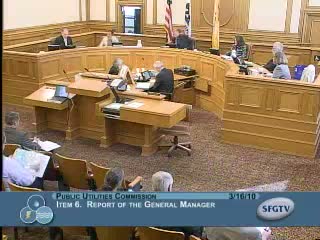
The Public Utilities Commission heard a wide-ranging briefing from Contracts Manager Ivy Fine on greener contract language, construction mitigation and digital procurement steps intended to reduce waste and help the utility prepare for California—s AB 32 greenhouse gas requirements.
Ivy Fine, manager of the Contracts Administration Bureau, told the San Francisco Public Utilities Commission that the department has begun embedding environmental requirements into professional service and construction contracts and is moving toward an electronic procurement system to reduce paper and improve oversight.
Fine outlined existing contract provisions that require recycled-content paper and ban certain harmful materials, noting that "the Food Service Waste Reduction Ordinance mandates that biodegradable, compostable, and recyclable food containers on all city requirements. So basically, no styrofoam." She described provisions that prohibit preservative-treated wood containing arsenic and bans on tropical or virgin redwood in both consultant templates and construction agreements.
The presentation also summarized mitigation measures used in the program environmental impact report (PEIR) and the Green Building Ordinance. Fine said project-level specifications commonly include restoration of pre-project conditions for trees and foliage, replacement of heritage trees and air-quality mitigation steps to control dust and exhaust emissions. She described the Green Building Ordinance as a framework to reduce energy use through efficiency, evaluate onsite renewable generation during project design, and aim for LEED Silver certification when appropriate.
Fine described several procurement modernization efforts: a short-term requirement that consultants submit proposals on CD while the commission builds an online e-procurement platform; adoption of an online insurance compliance system (Exigis); a construction management information system (CMIS) to centralize construction schedules, drawings and change orders; and an online invoicing system (Solus) to let vendors submit and track invoices electronically.
Commissioners pressed staff on how these contract requirements will be enforced and whether contractors are complying. Irina Torrey, manager of the Bureau of Environmental Management, placed the discussion in the AB 32 context, saying AB 32 is "a state bill that requires the state to go back to 1990 levels of greenhouse gas by 2012," and that the Bay Area Air Quality Management District is still developing guidance. Torrey said the PEIR already incorporated several mitigation measures that can be implemented now, and that the commission should expect future presentations tying AB 32 compliance to procurement and construction practices.
Commissioners also asked about penalties and incentives. Fine explained the distinctions among contract language — some provisions are contractual breaches (for example, use of arsenic-treated wood), while others are encouragements or ordinance-based requirements with their own enforcement mechanisms. Staff agreed to return with more detailed analysis, including a visual breakdown of PUC emissions sources so commissioners can see where contracting is likely to yield the biggest greenhouse-gas reductions.
The presentation left commissioners with a set of follow-up requests: a fuller briefing on AB 32 implications across PUC programs, an analysis of enforcement mechanisms and penalties for noncompliance versus incentive options, and a clear chart showing emissions by source to guide prioritization.
The commission did not take formal action on green contracting at this meeting; staff offered to return with the requested materials.