Get Full Government Meeting Transcripts, Videos, & Alerts Forever!
Get email alerts on the Jttf Mou Oversight topic
No spam. Unsubscribe anytime.
San Francisco officials debate oversight of SFPD participation in FBI Joint Terrorism Task Force
Summary
At a joint Police Commission and Human Rights Commission hearing May 18, 2011, community groups and civil-rights advocates pressed city officials over a secret 2007 MOU with the FBI and urged a transition to a resolution-based relationship to preserve civilian oversight; the police chief issued a May 16 bureau order requiring SFPD officers to identify as SFPD and said local policies take precedence.
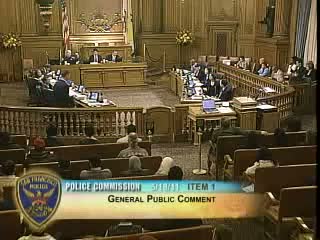
At a joint meeting of the San Francisco Police Commission and the Human Rights Commission on May 18, 2011, officials and community advocates debated whether San Francisco police officers assigned to the FBI's Joint Terrorism Task Force (JTTF) must operate under a 2007 memorandum of understanding (MOU) that critics say weakens local oversight.
Police Chief Sir said the department has issued a bureau order dated May 16, 2011, that requires members assigned to federal task forces to identify themselves as San Francisco police officers and reaffirmed that "San Francisco policies, procedures, laws, and statutes trump any federal policy or procedure." He also said he moved the unit back under Special Investigations so supervisors with the necessary clearances would oversee the work and pledged quarterly reviews of investigations involving the JTTF.
Why it matters: community advocates told the commissions that a previously secret 2007 MOU removed key checks on federal-local cooperation and has eroded trust in neighborhoods heavily represented by Arab, Middle Eastern, Muslim and South Asian residents. Speakers and civil-rights organizations argued that secrecy and the ability of federal authorities to block local reporting and oversight undermine established Department General Order 8.1 protections for First Amendment activities.
Presenters from the Asian Law Caucus and the American Civil Liberties Union urged the city to pursue a resolution-based approach (the model recently used in Portland) rather than rely on the MOU. Vina DuBall of the Asian Law Caucus said there are now "two ways for local law enforcement to participate in the JTTF" and described the resolution approach as providing "much better protection for civil rights and gives the SFPD and the Police Commission more control of the relationship." John Krug of the ACLU said the change would preserve local standards without requiring the city to leave the task force.
Commissioners pressed the chief and department staff on several technical and oversight points: whether the bureau order will adopt the explicit criminal-nexus language of DGO 8.1; how many officers are deputized or assigned to the JTTF (the chief declined to provide a specific current number but said there have never been fewer than two); how the Office of Citizens' Complaints (OCC) and a designated commissioner would access classified materials when necessary; and how liability and indemnification are treated under Section 21 of the MOU.
Community testimony was extensive. Dozens of residents, faith leaders and legal advocates recounted incidents they described as intrusive questioning, surveillance or improper information-gathering by federal or local authorities, and urged town-hall meetings in affected neighborhoods and a permanent ombudsman at the San Francisco Airport. The Human Rights Commission and community coalitions said they would facilitate town halls and continued meetings with the department and federal offices.
What was decided: the meeting did not produce a formal policy change or a vote on the transition option, but the chief's bureau order was presented as an interim mechanism to close perceived gaps. Commissioners recommended further revisions to the bureau order (including explicit language adopting DGO 8.1's standards where appropriate), asked staff to pursue clarity about OCC access and security clearances, and signaled interest in studying the resolution model as a next step. The commission moved to adjourn at the session's close and approved the adjournment by a voice vote.
Votes at a glance: the only formal motion recorded in the transcript was a motion to adjourn made by Commissioner Angela Chan and seconded (name not specified in the record). The motion passed by voice vote.
The next procedural step noted at the meeting was continued follow-up: the Human Rights Commission and Police Commission said they would continue meetings with community groups, the ACLU and the Asian Law Caucus and work to refine the bureau order or pursue a resolution-based path in subsequent agendas.