Get Full Government Meeting Transcripts, Videos, & Alerts Forever!
Get email alerts on the Wastewater Ssip topic
No spam. Unsubscribe anytime.
SFPUC details $3B-plus Sewer System Improvement Program; staff shows modeling that sharply reduces discharges
Summary
At a Feb. 9 special meeting, SFPUC staff presented conceptual components of a Sewer System Improvement Program (SSIP) including regulatory projects, state-of-good-repair work and green infrastructure. Modeling shows large volume reductions when hard and green measures are combined; cost estimates range into the billions.
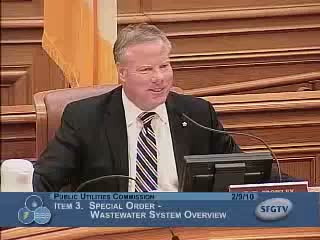
Karen Kubik, director of the wastewater capital program, outlined the conceptual components of a Sewer System Improvement Program during a Feb. 9 special meeting of the San Francisco Public Utilities Commission, telling commissioners that the package is intended to be developed through alternative analysis and environmental review.
Kubik said the SSIP is built around three buckets: regulatory projects to maintain permit compliance; state-of-good-repair work to address aging infrastructure; and environmental-benefits projects such as green infrastructure and biosolids reuse. "All of the projects we move forward with will be subject to a triple bottom line analysis," Kubik said, stressing that projects must be technically, environmentally and economically sound.
The presentation reported that the enterprise is currently in full compliance with its permits, and described regional-permit requirements — including the collection-system-focused "nine minimum controls" — that guide near-term regulatory work. On biosolids, staff said Solano County is tightening reuse requirements and that achieving a Class A biosolids product will be necessary to continue some beneficial reuse pathways.
On state of good repair, Kubik described a proposed sewer-replacement strategy that aims toward a 100-year replacement cycle for much of the collection system and identified needed treatment-plant upgrades and seismic work. Staff presented a long-range replacement estimate and said catch-up funding could reach into the billions; in the presentation staff estimated systemwide state-of-good-repair projects in the range of roughly $3.0 billion to $3.5 billion, with a Pier 94 digester siting option raising costs toward $1.5 billion for that element.
Modeling of combined solutions was a central focus. Staff said they ran 30 years of historic storms to create a representative annual storm series, then modeled combinations of hard infrastructure (tunnels, conveyance, storage), green infrastructure and private-side stormwater controls. The combined package reduced modeled Central Basin discharge volume from roughly 1.1 billion gallons per year to about 60 million gallons in the conceptual run and cut modeled occurrences of combined sewer discharges in several basins (for example, Central Basin modeled occurrences fell from 12 to 4 under the full package). Kubik said a modeled inflow reduction of about 19 percent is achievable with the preliminary suite of measures, noting the result is conceptual and subject to more detailed analysis.
Commissioners pressed staff to translate program-level goals into clearer, quantifiable levels of service tied to costs and timing — for example, how many miles per year of replacement would be funded under different budget scenarios, or what percentage of occurrences should be prevented to preserve the effectiveness of primary treatment in the box sewers. Kubik and modeling staff said they would return with additional runs that tie performance metrics to dollars and schedule.
On biosolids energy and reuse, staff described co-digestion of fats, oils and grease and additional drying to create a locally usable product; they said a reasonable market for local reuse tops out at about 10 percent of current biosolids production and that co-digestion could reduce net biosolids volume by about 30 percent while increasing methane available for onsite generation. Staff estimated on-site generation could be increased from roughly 30 percent to about 42 percent of wastewater enterprise electrical consumption under aggressive capture and optimization assumptions.
Next steps include refining service-level statements, further model runs to show trade-offs between hard and green investments, developing an implementation program and moving identified projects into CEQA and design phases. Commissioners asked staff to produce scenarios showing rate impacts and sequencing options so the Commission and public can weigh tradeoffs among cost, timing and performance.