Get Full Government Meeting Transcripts, Videos, & Alerts Forever!
Get email alerts on the Stormwater topic
No spam. Unsubscribe anytime.
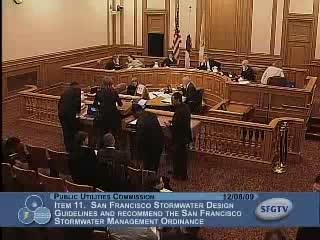
SFPUC staff proposes city stormwater design guidelines; commissioners defer final action to January
Summary
Staff presented stormwater design guidelines and a companion ordinance that would require on-site green stormwater management for new and redevelopment projects of 5,000 sq ft or more; commissioners requested more time to review climate-adaptation, wetlands and basin-scale impacts and voted to take up the item again in January.
Sarah Minnick, planner in the Urban Watershed Management Program, presented the San Francisco stormwater design guidelines and a proposed ordinance to the commission, explaining that the documents aim to meet Clean Water Act obligations and to coordinate with the city's green building ordinance. The guidelines require low-impact development (LID) measures on new and redevelopment projects of 5,000 square feet or more and provide technical compliance tools including fact sheets, a vegetation palette and a stormwater sizing calculator.
Minnick noted that in combined-sewer areas the guidelines focus on peak-flow attenuation and volume control, while in separate-sewer areas the focus is on water-quality protection and treatment prior to discharge. She highlighted potential system benefits with an example from Transbay Terminal design work showing a proposal that could divert roughly 1.8 million gallons annually through green infrastructure and reduce wastewater treatment and pumping energy.
Commissioners praised the technical work but asked for additional explicit language on climate change adaptation, wetlands restoration and basin-scale modeling of the guidelines' cumulative hydraulic impacts. Staff said other program elements (basin analyses, rainwater harvesting initiatives and modeling) are in progress and that the guidelines reflect minimum regulatory requirements; staff asked for flexibility to add further content. Given the volume and timing of materials (the packet was provided shortly before the meeting) and the policy importance of language on sea-level rise and wetlands, commissioners voted to defer formal adoption and asked staff to return with additional analysis and proposed amendments at the commission's earliest January meeting.
Next steps: staff will provide additional climate-adaptation and wetlands language as appropriate, share hydraulic-modeling results with the wastewater master plan team, continue stakeholder engagement, and return with a revised packet in January for action.