Get Full Government Meeting Transcripts, Videos, & Alerts Forever!
Get email alerts on the Disciplinary Procedure Reform topic
No spam. Unsubscribe anytime.
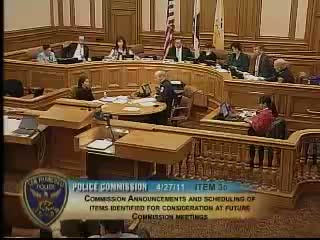
Police Commission adopts tighter timelines and monitoring for disciplinary hearings
Summary
After lengthy discussion, the commission approved amended procedural rules to speed disciplinary adjudications, tighten selection and monitoring of outside hearing officers, require earlier discovery, and mandate early face-to-face settlement conferences involving the chief or designee.
The San Francisco Police Commission voted on April 27 to adopt amended procedural rules intended to accelerate disciplinary adjudications and reduce backlog in administrative hearings.
Commissioner James Hammer, who led the drafting effort with the city attorney’s office, described the major changes: a commissioner monitor will be assigned to any case sent to an outside hearing officer; outside hearing officers must be selected and scheduled within a short timeline; hearings should begin within 90 days and finish within 120 days where practicable; hearing officers’ written reports will be subject to a 21-day deadline and page limit; discovery must be furnished to an accused officer within seven days after filing of charges; and an early, in‑person case-resolution conference is required within 15 calendar days, attended by the accused member and the chief or a designee with settlement authority.
"We have significantly tightened the rules surrounding the selection of outside hearing officers," Hammer said, describing a 14-day window to secure an outside officer and a commissioner-monitor role to prevent cases from languishing. He emphasized the goal of reducing multi-year delays in cases assigned to outside hearing officers and institutionalizing early settlement efforts.
Commissioners asked multiple clarifying questions about discovery deadlines, open versus closed proceedings, and whether the commission may deliberate in closed session without parties present. City attorney advisers explained that administrative adjudications are presumptively closed under prevailing law but that an officer may waive closed-session protections in writing; the commission retains discretion to deliberate in closed session to complete its decision-making.
Commissioner Petra de Jesus moved to accept the amended rules (including two oral clarifications proposed in the meeting). After public comment and brief clarifications from the city attorney and commission staff, the commission recorded affirmative votes and approved the rules.
Proponents said the changes will give accused members, the department and the commission clearer timelines and more prompt resolution; some public commenters and advocates urged caution about secrecy in closed proceedings and asked for stronger public reporting of disciplinary outcomes. The commission directed staff to incorporate the oral amendments into a consolidated final document and publish it with the stated timelines.