Get Full Government Meeting Transcripts, Videos, & Alerts Forever!
Get email alerts on the Infrastructure Wastewater topic
No spam. Unsubscribe anytime.
SFPUC workshop lays out three-tier levels of service for sewer overhaul, gives cost and performance estimates
Summary
At a Jan. 2010 workshop, SFPUC staff presented three levels of service for a 20–30 year Sewer System Improvement Program, including modelled overflow reductions (Level II: 25–45% volume reduction), estimated cost ranges and a Feb. 9 follow-up for staff recommendations.
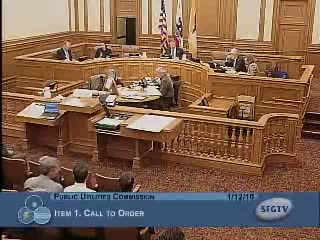
Karen Cubing, director of the Sewer System Improvement Program at the San Francisco Public Utilities Commission, told commissioners on Jan. 12, 2010, that staff have modelled three ‘‘levels of service’’ options to guide a long-term sewer system improvement program and that the models will inform a staff recommendation at a follow-up workshop scheduled for Feb. 9.
The staff presentation grouped interventions into three tiers. Roman numeral I represents baseline compliance work; Roman numeral II adds major capital projects and aggressive low-impact development (LID); Roman numeral III includes additional treatment, pumping and emergent technologies. "The Level II system can reduce that combined storage discharge volume by 25 to 45%," Cubing said, citing model runs that used a century of rainfall data with recent decades emphasized. Staff described the model runs as estimates and said some inputs remain to be refined.
Why it matters: staff handed commissioners a rough performance and cost picture so policymakers can weigh trade-offs between reducing the total volume of annual combined discharges and lowering the frequency of overflows. Staff reported a baseline annual overflow in the model of about 1,400,000,000 gallons and noted Level II delivered significant volume reductions while frequency was harder to move. Staff also reported that conversion of impervious surfaces through LID at a rate of 1% per year over 30 years reduced modeled stormwater flows by about 19.7% in a straight-line scenario.
Costs and schedule: staff presented order-of-magnitude cost ranges tied to the three packages: a baseline package roughly $1.5 billion, a set of major capital projects about $5.8 billion, and a higher-level/future technology package on the order of $11 billion. Commissioners and staff repeatedly characterized these as planning estimates that a program manager and additional hydraulic modelling will refine. Staff said the overall program horizon is on the order of two to three decades and that projects will be sequenced after further modelling and budget work.
What commissioners asked for: several commissioners requested maps and basin-level breakout data showing where overflow reductions and LID placement would deliver the greatest local benefit. One public commenter, Jennifer Clary of Clean Water Action, urged that staff show whether proposed conveyance projects such as tunnels simply relocate flows to another outfall and asked that pollutant loading—particularly emerging contaminants—be included explicitly in future analysis.
Next steps: staff said it will return with more geographically specific modelling and a staff recommendation that ties selected levels of service to estimated rate impacts, budgets and a recommended project sequence. The commission did not take action on any policy decision during the workshop.