Get Full Government Meeting Transcripts, Videos, & Alerts Forever!
Get email alerts on the Patrol Specials topic
No spam. Unsubscribe anytime.
Commission presses action after report finds gaps in patrol-special officers’ insurance, range qualification and paperwork
Summary
A police commission report found 42 patrol-special officers on the books (27 active), with several failing to provide proof of insurance, missing informational sheets and at least three failing firearms qualifications; commissioners urged immediate steps to remove officers from beats until compliance is confirmed.
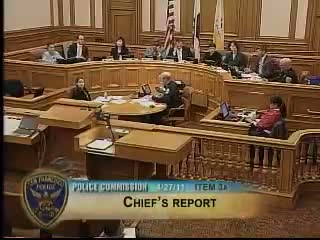
The San Francisco Police Commission on April 27 took up a detailed presentation on patrol-special officers’ compliance and pressed the department to act quickly to protect public safety.
Lieutenant Henry Perra told the commission his review of department records found 42 patrol-special officers on the roster, 15 of whom were inactive, leaving 27 active patrol-special officers, including nine identified beat owners. "We have a total of 42 patrol special officers," Perra said, and described a broader set of compliance issues: only 28 of the city's 67 beats are actively worked; three of nine beat owners had not submitted required proof of insurance; 10 of 27 active officers had not submitted informational sheets; and three failed to qualify at the range and were referred to management control.
Perra said the department issued a bulletin (dated 04/26/2009) restating interim rules: patrol specials must not use emergency lighting or sirens, may not issue citations, may not engage in vehicle pursuits, must maintain specified uniform and equipment, and must submit proof of insurance and worker’s compensation coverage with an indemnity clause for the city.
Commissioners and staff described the gaps as a public-safety and liability risk. Commission President Thomas Mazuko and several members said officers who have not qualified with firearms or who lacked insurance should not be on the street. "If somebody isn't qualified, they should be off the street," one commissioner said. Commissioners discussed legal options, including immediate suspension by the chief under current rules in cases raising public-safety concerns and forwarding noncompliant cases to internal affairs or management control.
Deputy City Attorney Katie Porter responded that under the rules the chief has authority to temporarily suspend a patrol special pending a hearing and that a 30-calendar-day timeline applies to bring the matter to the commission. Commissioners asked Perra to return with a beat map showing where noncompliant officers work and asked that the three officers lacking firearms qualification or insurance be stood down immediately while formal steps proceed.
Public commenters, patrol-special representatives and business owners also addressed the commission, urging both enforcement and fair treatment. Representatives of the patrol specials said many members were complying and urged clarity on records and retention of client lists, which some patrol specials described as proprietary.
The commission asked the department and OCC to produce status updates and scheduled follow-up reporting; commissioners signaled they were prepared to take formal action if the chief did not or could not enforce immediate stand-downs for the most serious safety-related violations.
The discussion clarified which compliance failures are safety-critical (weapons qualifications and insurance) and which are procedural (informational sheets and client-list recordkeeping), and set next steps for the chief’s office and the commission.