Get Full Government Meeting Transcripts, Videos, & Alerts Forever!
Get email alerts on the Bay Delta Legislation topic
No spam. Unsubscribe anytime.
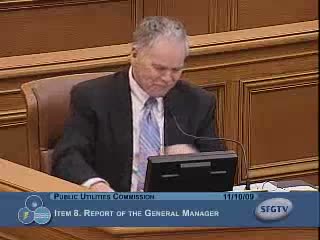
PUC staff outlines implications of new Bay‑Delta legislation, bond and reporting rules
Summary
Deputy GM Michael Carlin briefed commissioners on five pieces of state legislation affecting the Bay‑Delta — including a Delta Stewardship Council, a water bond (identified as SBX X7‑2, ~$11.144B final), groundwater monitoring and diversion reporting — and said staff will produce a detailed analysis of local impacts.
Deputy General Manager Michael Carlin told the commission the state legislature passed five related measures during a special session addressing Bay‑Delta governance, funding and reporting.
Carlin said the Delta Protection Act creates a seven-member Delta Stewardship Council charged to produce a Delta Plan and a Delta Watermaster with delegated enforcement authority from the State Water Resources Control Board. He said the legislation also sets up a Delta Independent Science Board and a Sacramento–San Joaquin Delta Conservancy "to try and balance the needs of the people in the Delta with the resources in the Delta."
On funding, Carlin identified the bond referenced in the bills as "SBX X7‑two," which he said began at about $9.1 billion and was $11.144 billion on the final night. He said the bond stages spending across 2010–2015 and 2015–2020 and earmarks funds for storage, conservation, groundwater cleanup and water recycling.
Carlin described a groundwater-monitoring requirement that places reporting responsibility at the basin level (not per well), and a new diversion‑reporting requirement that brings pre‑1914 water rights into the reporting system; he said SFPUC already reports diversions voluntarily and will likely be able to meet the new requirement without operational change. He also noted the legislation directs the State Water Resources Control Board to develop in‑stream flow criteria within 12 months and that the State Board added 25 enforcement staff for water-rights enforcement.
Commissioners asked for specifics on how the new laws affect SFPUC operations; staff committed to return with attorneys and a written report at the Dec. 8 meeting and to provide a more detailed analysis of implementation, legal effects and any funding opportunities or obligations. Several commissioners said the legislation's aggressive timelines (e.g., council plan by 2012 and in‑stream criteria within 12 months) may be difficult to meet in practice.
A staff speaker described the agency's shift from initial opposition to conditional support after negotiating statutory language with legislators and stakeholders to protect local water rights and to preserve appropriate administrative processes. "Did we get everything we would have wanted? No. Did we get the things important to protect our water rights? Yes," the speaker said.