Get Full Government Meeting Transcripts, Videos, & Alerts Forever!
Get email alerts on the Police Use Of Force topic
No spam. Unsubscribe anytime.
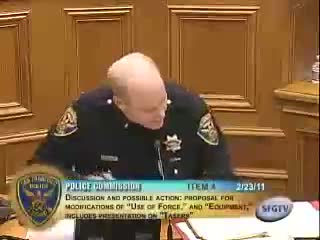
Police commission directs chief to study tasers and other less‑lethal tools after hours of testimony and public comment
Summary
After expert testimony and several hours of public comment, the San Francisco Police Commission voted 6–1 on Feb. 23, 2011, to direct the police chief, the Office of Citizen Complaints and two commissioners to develop DGO changes and a proposed pilot for conducted energy devices and other less‑lethal options, with stakeholder consultation and a 90‑day report back.
SAN FRANCISCO — The San Francisco Police Commission voted 6–1 on Wednesday to ask the police chief to develop proposals for adding conducted energy devices (CEDs) such as TASERs — and to evaluate other less‑lethal options — as part of a potential pilot program, after more than eight hours of expert presentations, role‑play demonstrations and public comment.
The motion, carried after a roll call vote, directs the chief of police to work with the Office of Citizen Complaints (OCC) and two commissioners to draft proposed changes to Department General Order 5.01 (use of force) and DGO 10.02 (equipment), to identify costs and funding, and to return to the commission with findings in 90 days. The commission also required consultation with stakeholders including communities of color, mental‑health professionals and LGBT organizations, and asked for a review of departmental tactical training.
“Ultimately, we need one more weapon to protect the officers and the public,” Commission President Thomas Mazzucco said in opening remarks, framing the night’s debate around officer safety and civilian harm. “We want to limit the number of shootings, and we’d like to give the officers the tools they need.”
Interim Chief Jeff Godown told the commission he was not asking to arm officers overnight. “I am asking for permission to go back and research the feasibility of looking for a less‑lethal weapon, including the implementation of a taser,” he said, adding that he planned to involve community stakeholders and expected to identify a candidate within about 30 days and to take six to 12 months to develop a full implementation plan if the commission directed him to proceed.
The department opened the hearing with a role‑play demonstration of a domestic disturbance in which officers said existing options — OC spray, baton or carotid control — sometimes require officers to close to dangerous proximity. Commander Daniel Mahoney described a pilot project that the department would seek to include vendor selection, a policy with oversight and automatic reporting to OCC, training and community outreach.
Supporters of a limited pilot included police line officers and local law‑enforcement leaders who described violent incidents in which they said a remotely deployable tool might have reduced the risk of a shooting. “We need something in between the baton and the firearm,” Sergeant Joe McCloskey said, describing a brief, violent altercation that left him reaching for his gun.
Sheriff Mike Hennessy described the San Francisco Sheriff’s Department experience: the sheriff said his department has carried TASER devices since 2002, reported 14 discharges and had taken a TASER to the scene roughly 69 times, and described restrictive deployment rules and training.
But those endorsements were countered by medical and civil liberties testimony that raised questions about safety and misuse. Dr. David Tsang, a cardiologist at UCSF, summarized a peer‑reviewed study of California agencies that found a rise in in‑custody sudden deaths in the first year after TASER introduction — rising from roughly 1 to 6 sudden deaths per 100,000 arrests in the study’s sample — and urged strict limits on targeting (avoid the chest), limits on repeated shocks and the availability of automated external defibrillators (AEDs).
Performer and policy expert Dr. Chuck Wexler of the Police Executive Research Forum cited NIJ‑supported research that PERF has compiled and said, in their review, CED adoption has been associated in some studies with reduced officer and suspect injuries when tightly constrained by training and oversight. “When used properly, CEDs can serve as a useful addition to the use‑of‑force continuum,” Wexler told the commission.
Civil‑liberties organizations and oversight experts pressed for caution or rejection. Representatives from Amnesty International, the ACLU and independent oversight practitioners presented case examples, video excerpts and years of reported incidents they say show frequent misuse, disproportionate use against vulnerable people and a risk that CEDs become a first resort rather than a last one. “CEDs are often used as tools of routine force rather than as an alternative to firearms,” Rini Chakraborty of Amnesty International testified.
Public comment filled much of the evening. Speakers — including mental‑health advocates, legal groups, neighborhood residents and community organizations — urged the commission to prioritize the newly adopted Crisis Intervention Team (CIT) initiative and to study alternatives. Many speakers raised concerns about budget, racial disparities in use and the risk to people who are intoxicated, thin, elderly, pregnant or medically fragile.
Commission debate after testimony focused on three priorities, according to commissioners: finish rolling out the CIT program that the commission adopted recently; review and strengthen tactical training and use‑of‑force policies; and, if warranted, examine intermediate, less‑lethal options through a carefully scoped pilot. Several commissioners recommended the research be independent, that costs and procurement implications be spelled out, and that any pilot include limits on who may carry the devices and strict reporting and review requirements.
Commissioner James Hammer moved the proposal to authorize the chief to research and draft the DGO changes and pilot proposal; the motion included the OCC and two commissioners working with the chief, stakeholder consultation, proposed cost estimates and a tactical‑training review. Commissioner Dr. Joe Marshall seconded the motion. The motion passed on roll call 6–1; Commissioner Petra De Jesus cast the lone no vote.
Under the vote, the department and the OCC must report back within 90 days with recommended devices (if any), proposed policy language for a pilot, estimated costs and a plan for community consultation. Any actual deployment beyond a pilot would require a subsequent commission vote and DGO approval. The commission specified that a pilot’s DGO language would be temporary for the duration of the pilot and that a future commission decision would be required before broader deployment.
The commission also reiterated that the CIT initiative will proceed; several commissioners said CIT rollout and specialized crisis training are prerequisites for any broader operational change.
The chief said he would pursue community input and the requested analysis and stressed he would not implement any deployment without commission approval. “I’m not asking permission to go back and arm the officers on this department with tasers. I will have to come back,” he told the commission during the hearing.
The commission closed the meeting after votes on personnel items and nondisclosure for the closed session.