Get Full Government Meeting Transcripts, Videos, & Alerts Forever!
Get email alerts on the WESIP topic
No spam. Unsubscribe anytime.
SFPUC reports major schedule and cost variances in WESIP; Calaveras Dam drives largest increases
Summary
PUC staff told commissioners the Water Enterprise System Improvement Program faces schedule delays and cost increases, with the Calaveras Dam replacement accounting for a 42‑month slip and a $101 million increase largely tied to natural‑occurring asbestos and fisheries mitigation.
The San Francisco Public Utilities Commission heard a quarterly update Tuesday showing the Water Enterprise System Improvement Program (WESIP) is making progress on construction but facing notable schedule and cost variances that will affect the program through 2015.
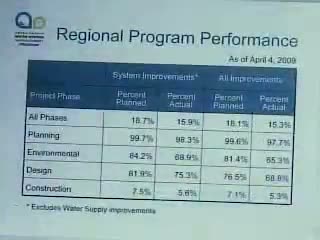
Julie Levante, presenting the fiscal third‑quarter report for FY 2008–09, said local projects are largely in construction and regional projects are advancing in design but continue to be delayed by environmental review. ‘‘Performance on the local program is…very good,’’ Levante said during the presentation. She told commissioners that, as of April 4, construction was under way on about half the local projects and that 45 of 84 WESIP projects were either complete or in construction.
Levante singled out the Calaveras Dam replacement as the program’s most significant schedule and cost driver. The project’s completion date has moved from earlier forecasts to a 42‑month delay, and the forecasted cost has increased by about $101 million, Levante said. She broke that figure down: roughly $63 million is for mitigation related to naturally occurring asbestos (NOA), $31 million for fisheries‑related requirements and roughly $8 million for geotechnical and other issues. ‘‘We had just got one hit of NOA and did not comprehend how extensive and how high the concentrations are,’’ Levante said.
Todd Reitstrom, the PUC’s chief financial officer, summarized the financing implications: ‘‘For every $100 million we go over budget on the project side, it’s about $7 million more a year in annual debt service costs,’’ he said, noting the agency’s longer‑term debt service projections.
Staff told the commission the overall WESIP program variance stood at about $197 million on the latest forecast but noted that forecast is lower than the prior quarter by approximately $71 million after new bids and updated estimates. Levante said the program completion date is now being reported as Dec. 4, 2015, with the Calaveras project controlling that schedule.
Commissioners pressed staff on causes for the variances and the accuracy of earlier estimates. Irina Torrey of the Bureau of Environmental Management told the commission that early consultant estimates understated environmental review scope and that EIRs “generally cost at least a million dollars and usually more than that.” Commissioners emphasized the need for tighter early‑stage estimating and cautioned that parallel design and environmental work can cause changes in scope and additional cost during the process.
Levante and staff said they will continue to provide updated bid and schedule information as the program moves forward and noted several mitigation steps and value‑engineering efforts already underway to reduce future cost exposure.
The PUC will present additional WESIP financial materials, including bond‑issue planning and financing assumptions, at a future meeting. The commission did not take a separate vote on WESIP at Tuesday’s session.