Get Full Government Meeting Transcripts, Videos, & Alerts Forever!
Get email alerts on the Power Generation Potrero Closure topic
No spam. Unsubscribe anytime.
SFPUC staff outlines steps to enable Potrero Power Plant closure, cites $1–4M transmission fix
Summary
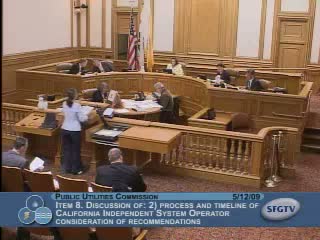
SFPUC presented technical and policy options to release Potrero Power Plant from ISO reliability requirements, including installing 2–4 series reactors (estimated $1–4 million), targeted energy efficiency/demand response, and relying on the Transbay cable coming online. Public commenters urged earlier closure of the most polluting unit.
San Francisco Public Utilities Commission staff on May 12 presented a plan for how the city might seek near‑term closure of the Potrero Power Plant while preserving electric reliability. Barbara Hale, assistant general manager for power, told commissioners that California Independent System Operator (Cal ISO) studies show a relatively small summer 2010 reliability gap — roughly 25 megawatts in the ISO’s 2010 scenario, dropping in later years — and that modest transmission changes could eliminate the need for continued ‘must‑run’ contracts for Potrero’s units.
Hale said the plant includes Unit 3, a roughly 206‑megawatt natural‑gas unit with once‑through cooling, and three peaker units (Units 4–6) of about 52 MW each. She described a near‑term proposal to install 2 to 4 series reactors on PG&E’s 115‑kV transmission system at substations such as Futuro or Martin. “A 2 to 4 of them would cost $1 to $4 million,” she said, calling it “a very modest change” that could reroute flows and relieve overloaded lines so the ISO would no longer require Potrero to be held for reliability in some scenarios.
The staff presentation also outlined other near‑term measures: updating ISO load forecasts to reflect economic changes, moving forward on PG&E transmission projects (including the Martin–Hunters Point cable), targeted energy‑efficiency and demand‑response programs for customers served from the Potrero substation, and considering a remedial action scheme (an emergency operating plan) for rare extreme peak events. Hale said the Transbay cable’s planned operation in 2010 is central to the ISO’s calculus; the ISO has indicated it will release Unit 3 once the Transbay cable is online, though staff said ISO staff have argued the unit may still be needed into late 2010 depending on assumptions.
Why it matters: Potrero’s operation affects neighborhood air quality in southeast San Francisco and the city’s long‑standing policy objective to reduce in‑city fossil generation. Speakers from Bayview–Hunters Point and advocacy groups praised the staff’s analysis. Community member Espanola Jackson urged the commission to close the plant by the end of the year so neighborhood residents can “start breathing fresh air.” Joshua Arce of Bright Line Defense Project said broad political support exists for closure without building new fossil plants to replace it.
Regulatory timeline and next steps: Hale said Cal ISO will submit its reliability plan to the California Public Utilities Commission in May, the CPUC is expected to act in June, ISO board designations and FERC filings are likely in the fall and winter, and the SFPUC will work with Rocky Mountain Institute (RMI) over the coming 6–9 months to update the city’s integrated resource plan. RMI’s work will produce a financially feasible portfolio of demand‑side, renewable, transmission and smart‑grid alternatives tailored to San Francisco’s needs.
Questions from commissioners focused on the permanence of the series reactors (staff said they would be permanent modifications within existing substation footprints and would not require CEQA review), who would handle environmental cleanup post‑closure (PG&E, as prior owner, has funds and is engaged with the Port), and how distributed solar projects are counted by ISO (intermittent resources are discounted but do contribute). Hale said the city will press ISO to use updated load forecasts — which postdate the economic downturn — and to consider the proposed transmission and demand‑side solutions when making its reliability determinations.
Public reaction and constraints: In public comment, Francisco de Costa cited the Raker Act and contested jurisdictional limits where PG&E owns transmission, and urged immediate retirement of the most polluting unit. Community speakers emphasized health and equity concerns in Bayview–Hunters Point and asked the commission to be transparent about its timeline and decisions.
What the commission did: The presentation was informational; no formal action was required. Staff left copies of the presentation and a letter expressing citywide support at the public table and said it would return with updates as regulatory steps progress.
Next step: SFPUC staff will continue stakeholder engagement, work with RMI on the integrated resource portfolio over the next 6–9 months, and monitor ISO/CPUC/FERC schedule related to reliability contract designations and possible release of Potrero units.