Get Full Government Meeting Transcripts, Videos, & Alerts Forever!
Get email alerts on the Mental Health Training topic
No spam. Unsubscribe anytime.
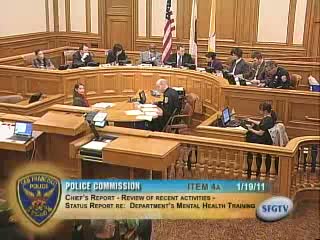
S.F. police outline faster mental-health crisis training; commissioners press pace, funding and partners
Summary
The Police Department presented a retooled crisis intervention training program that shifts a 40-hour off-site course into a 24-hour in-house class to be offered monthly, tripling annual throughput to about 360 officers; commissioners and community speakers pressed for faster rollout, clarity on funding and continued community partnerships.
Assistant Chief Denise Schmidt told the Police Commission on Jan. 19 that the department has reworked its previous 40-hour Police Crisis Intervention Training into a 24-hour in-house course it plans to offer monthly, training about 30 officers per session and roughly 360 officers per year.
Schmidt said San Francisco had been cited as a model when the state developed post-mandated crisis-intervention elements, and that the old 40-hour program had trained roughly 929 officers over its lifetime. The new model, she said, preserves key components — recognition of mental illness, de-escalation, conflict resolution and use of community resources — while allowing the department to present the class once a month.
Commissioners asked several detailed operational and budget questions. Commissioner Petra DeJesus said the pace was too slow for a department with many street-level contacts and cited a prior year in which three 40-hour sessions trained roughly 120 officers. Schmidt and others responded that the new schedule represents three times the prior annual throughput. Schmidt estimated the annual cost to run the monthly 24-hour series, including outside subject-matter experts, at roughly $88,000.
Several commissioners and public commenters pressed the department to keep community partners involved. Commissioner Angela Chan asked which community partners had been engaged in developing the 24-hour curriculum; Schmidt offered to provide the curriculum and a partner list for the commission's review. Commissioners also emphasized integrating training with operational protocols and with emergency- and mental-health partners so officers receive timely information on calls.
Public commenters, including organizers and family members affected by officer-involved incidents, urged speedy, citywide training and questioned whether spending priorities favored weapons over training. The commission scheduled a full hearing focused on mental-health responses and asked staff to invite local and out-of-town experts, mental-health professionals and departmental representatives to present models and implementation details.
The commission directed three commissioners to refine proposals and meet with department liaisons before a broader working session. The goal for the department is to roll out the 24-hour course beginning in February and to provide the commission with a clear implementation plan, partner list and budget.