Get Full Government Meeting Transcripts, Videos, & Alerts Forever!
Get email alerts on the Water Rates topic
No spam. Unsubscribe anytime.
SFPUC adopts five‑year water and wastewater rate schedules to fund system rebuild
Summary
The San Francisco Public Utilities Commission approved new rate schedules for 2009–2013 to finance a multi‑billion‑dollar water system improvement program, while commissioners and members of the public debated the affordability of the increases and low‑income assistance measures.
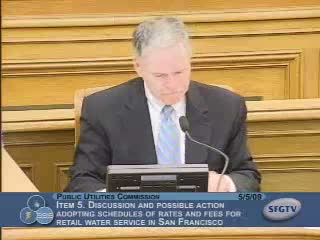
The San Francisco Public Utilities Commission voted on May 5, 2009, to adopt multi‑year water and wastewater rate schedules effective with meter readings beginning July 1, 2009, through July 1, 2013, to help finance the agency’s Water System Improvement Program (WSIP).
Commissioners approved items 5 through 8 by voice vote after staff described the increases as primarily driven by capital needs and debt service rather than operating costs. Todd Reedstrom, SFPUC chief financial officer and assistant general manager, said the typical single‑family combined water and sewer bill would increase roughly 9.9 percent per year on average over the five years and characterized the work as necessary to “continue to bring safe reliable drinking water to San Francisco and to our suburban customers.” Reedstrom told the Commission the WSIP will require roughly $4,400,000,000 in capital investment and that the proposed rate path is designed to meet bond covenants and revenue sufficiency requirements.
Reedstrom and staff explained elements of the proposal intended to limit household impacts. The package includes a two‑tier (inclining block) rate structure, conservation incentives and a low‑income assistance program the presentation called the “angel fund.” Reedstrom said the proposed $1.3 million assistance package combines $254,000 from prior revenue closeouts and a proposed $1,000,000 transfer in the mayor’s budget; it is intended to provide discounts (staff described roughly 35 percent wastewater discounts and 15 percent water discounts for eligible single‑family customers), a multifamily nonprofit housing component administered through the Mayor’s Office of Housing, and a direct‑install toilet replacement program targeting about 3,500 households per year.
Commissioners asked for follow‑up reporting on program uptake and on usage patterns among large commercial and wholesale customers. Reedstrom said about 7,200 single‑family accounts currently participate in assistance programs and that staff would return with utilization updates and summaries of high‑use commercial sectors. Staff also reminded the Commission of public protest rules under Proposition 218 and reported 170 written protests had been received among approximately 230,000 mailed notices.
Members of the public raised affordability concerns during the public‑comment period. Barry Claggett of Ingleside Terraces told the Commission his household’s bill would "slightly more than double over 5 years," calling the cumulative increase excessive. William Fong, a property owner, urged a freeze on the increases and said landlords would likely pass costs to tenants. Art Jensen of Vosca praised the clarity of staff materials but warned the cumulative effect will be substantial and urged continued communication with stakeholders.
Commission action: A motion to adopt items 5–8 and to amend the citation in Resolution No. 8 to show the wholesale rate per 100 cubic feet was moved and seconded and approved by voice vote. The transcript records the motion and the chair’s announcement that "the motion carries," but does not record individual roll‑call vote tallies.
The Commission and staff emphasized that voters approved the original WSIP funding measure (Proposition A, 2002) and that the rate path was intended to provide stable revenue to meet debt service and complete critical seismic and reliability upgrades. The meeting adjourned at 11:10 a.m.