Get Full Government Meeting Transcripts, Videos, & Alerts Forever!
Get email alerts on the Use Of Firearms Policy topic
No spam. Unsubscribe anytime.
Police Commission to Consider Formal Revision of Use-of-Firearms Policy After Bulletin Restricting Firing at Moving Vehicles
Summary
The commission heard a presentation on Departmental Bulletin 10-156, which narrows circumstances when officers may discharge firearms at moving vehicles and will be folded into a revised Department General Order (DGO 5.02). Commissioners pressed for a public hearing and an adoption timeline in early 2011.
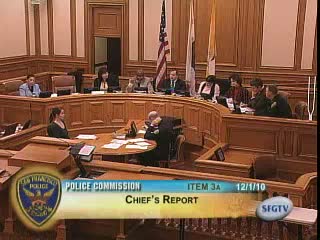
The San Francisco Police Commission on Dec. 8 received a briefing on Departmental Bulletin 10-156 and ongoing work to rewrite Department General Order 5.02 governing use of firearms.
Sergeant Mike Nevin of the SFPD’s internal affairs, officer-involved-shooting investigation team told commissioners the priority bulletin — issued in February and currently in effect — was adopted to clarify and tighten the department’s language on discharging a firearm at or from a moving vehicle. He said the bulletin reflects recommendations from the Police Executive Research Forum’s assessment and an internal five-year study of officer-involved shootings that concluded the tactical disadvantages of firing at moving vehicles generally outweigh potential benefits.
Nevin said the bulletin states that “a firearm shall not be discharged out of [or] at a moving vehicle unless a person in the vehicle is immediately threatening the officer or another person with deadly force by means other than the vehicle itself.” He said the bulletin will remain in effect until a forthcoming revision to DGO 5.02 is completed and presented to the commission for formal consideration.
Commissioners pressed for clarity about how the bulletin is distributed and trained on: Nevin said the priority bulletin required officers to sign for receipt, and training modules and force-options instruction at the academy and in-service were already updating officers about PERF and internal study findings. He said the written directives unit will shepherd the DGO revision through meet-and-confer with the Peace Officers’ Association (POA), the Office of the City Attorney and the OCC before the commission sees a formal DGO.
Commissioner Jim Hammer asked whether the bulletin forces an officer to choose between safety and compliance; Nevin and other department representatives said use-of-force decisions will continue to be judged under the Fourth Amendment’s objective-reasonableness standard and assessed case-by-case. Several commissioners said they believed the bulletin provided more clarity than the prior 1995 DGO language, which they described as confusing because it listed the practice under “prohibited circumstances” but then carved out permitted exceptions.
Multiple commissioners urged the department to set a date certain for public consideration. Commissioner Hammer asked for the matter to be placed on a January agenda; other commissioners and department staff said the holidays and required meet-and-confer process made February a more realistic target for bringing the full DGO revision forward. The commission directed staff to schedule a hearing and to ensure OCC and city attorney participation in the review process.
The commission did not vote on the DGO at the meeting; staff said they would return with the formal revision and associated training plans for the commission’s public consideration.