Get Full Government Meeting Transcripts, Videos, & Alerts Forever!
Get email alerts on the Officer Involved Shooting topic
No spam. Unsubscribe anytime.
Police chief lays out stricter reviews, training and timelines for officer‑involved shootings
Summary
San Francisco Police Department leaders told the Police Commission on Nov. 10 that the department redefined officer‑involved shootings to capture any intentional discharge, described parallel criminal and administrative reviews, and outlined retraining and return‑to‑duty practices.
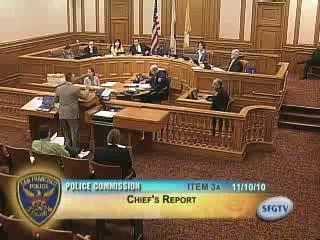
Chief George Gascon and internal‑affairs staff presented a step‑by‑step account of how the San Francisco Police Department investigates officer‑involved shootings (OIS), telling the Police Commission on Nov. 10 that the department has updated definitions, strengthened timelines and expanded training.
"Anytime that an officer intentionally discharges a firearm, regardless of whether he hit the target or not, should be investigated as an officer‑involved shooting," Chief Gascon said during the presentation, describing a February bulletin that redefined OIS to align with best practices used by peer agencies.
Sgt. Mike Nevin of the department’s OIS team summarized the process: a criminal investigation is handled by homicide detectives and the district attorney’s office; an administrative investigation is conducted by Internal Affairs; both tracks feed the department’s Firearms Discharge Review Board (FDRB). Nevin described the department’s target timelines (a 45‑day turnaround for commanding‑officer reports where feasible) while noting legitimate delays when, for example, the medical examiner or criminal case timelines require longer review.
The department also described interim steps intended to protect officers and public safety: a return‑to‑duty panel convenes within five business days after an OIS to recommend whether officers should resume regular duty, and involved officers are reassigned to administrative duties for a minimum of 10 calendar days while they receive confidential debriefing, behavioral‑science counseling and range or force‑options training. Sergeant Nevin said these measures are ‘‘not punitive’’ but part of a standardized post‑incident process.
Commissioners pressed staff on the bureau’s backlog and case age. Nevin said most older cases have been cleared: only one case from early 2009 remained for presentation to an upcoming FDRB, and most active cases are from 2010. The next FDRB was scheduled for December.<br><br>
The chief framed the changes as part of transparency and continuous improvement: he said the department now publicly posts materials about the OIS review process, will update training regularly and is committed to making chief‑summary letters available to the commission without names but with investigatory context. He also acknowledged that some legal and federal limits determine what may be publicly disclosed and said the department is coordinating with the city attorney on those issues.
The commission did not take formal action on policy revisions at the meeting but used the presentation and Q&A to direct staff and counsel to continue developing updated guidance for future review and possible rule changes.