Get Full Government Meeting Transcripts, Videos, & Alerts Forever!
Get email alerts on the Police Discipline topic
No spam. Unsubscribe anytime.
Police commission weighs tighter timelines for officer disciplinary hearings
Summary
Commissioners discussed a package of proposed changes aimed at shortening delays in officer disciplinary cases, including assigning a commissioner to monitor cases, faster selection of hearing officers, shorter hearing officer reports and allowing penalty consideration the night a finding is sustained.
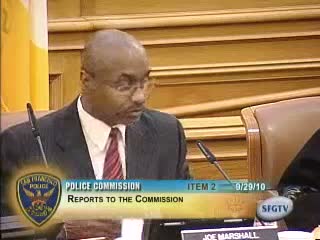
A San Francisco Police Commission discussion on Sept. 29 focused on a set of proposed revisions to the commission's disciplinary hearing rules designed to cut months from the current process.
A draft circulated to commissioners would: assign a commissioner to monitor each case once filed; require parties to agree on a hearing officer within 14 days and select a hearing date within 90 days; allow the commission to reassign cases languishing more than 90 days; shorten hearing officer reports to a 10-page limit delivered within 10 days focused on observations of demeanor and credibility; and permit the commission to consider penalty on the same night it sustains a finding or continue penalty consideration up to 21 days.
"We set time limits with the idea ... that we'd had several old cases and things had bogged down a bit," the presenting commissioner told colleagues, outlining the five main areas of revision. The draft credited input from the department's Lieutenant Riley and from Ms. Blitz, both of whom the presenter said had reviewed the proposals.
Commissioners debated several details as they sought a balance between expediting cases and preserving due-process information. Commissioner Chan supported shortening reports but urged keeping a hearing officer recommendation on whether each charge was supported by sufficient evidence, saying such a recommendation is "helpful to have" even if the commission is not bound by it. Other commissioners proposed keeping an initial short report focused on demeanor but having the hearing officer available or submit a brief recommendation at the decision stage so commissioners could ask follow-up questions in person.
On case monitoring and reassignment, commissioners discussed whether the commission secretary or an assigned commissioner should trigger calendar review when a matter has not reached hearing within 90 days. The presenter said an assigned commissioner could add the case to a future agenda for possible reassignment, while some members favored automatic inclusion by the secretary to ensure consistency.
No formal vote was taken on the changes at the Sept. 29 meeting. The presenter said the next step was to instruct the city attorney to start meet-and-confer discussions with the Police Officers' Association and return a final draft for future action. "I can indicate to the city attorney that we're ready for meet and confer," the presenter said.
The commission scheduled continued review of the supplemental rules at a later meeting; commissioners emphasized the goal of reducing costs and delays while retaining enough information for the commission to reach an informed independent judgment.
The commission also heard public comments urging better discovery practices so that charges are filed only when an investigation and discovery packet exist and advocating formal pretrial settlement opportunities involving department decision‑makers.
The commission did not adopt the proposed rule changes on Sept. 29; commissioners asked staff and city counsel to proceed with follow-up steps so the matter can return for formal consideration.