Get Full Government Meeting Transcripts, Videos, & Alerts Forever!
Get email alerts on the Capital Programs Wesip topic
No spam. Unsubscribe anytime.
WESIP quarterly report: several regional projects face environmental-review delays and $268M forecast variance
Summary
The Water System Improvement Program is on track for many local projects but faces environmental-review and schedule slippage on large regional projects (Calaveras Dam, PEIR) and a forecasted $268 million program variance driven largely by the Harry Tracy project; staff described mitigation steps and a planned risk assessment.
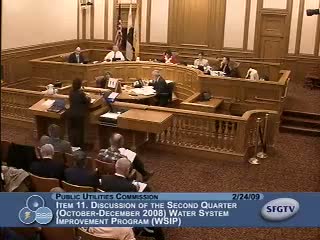
Julie Labonte, director of the Water System Improvement Program, presented the second-quarter fiscal-year report covering Oct.–Dec. 2008. She said local projects are roughly 52% complete and mostly tracking to plan, while regional projects are more complex and lag in environmental phases. Labonte cited Calaveras Dam and the Program Environmental Impact Report among the items contributing to schedule variance.
Staff reported a forecasted program-level increase of approximately $268 million against the approved WESIP budget of $4.4 billion; about two-thirds of that variance was attributed to the Harry Tracy project, with escalation and soft-cost increases also noted. Labonte and CFO Todd Reedstrom said commodity-price declines (notably steel) and a competitive bidding environment may reduce some forecasted variances when contracts are advertised and bids received, but cautioned that some cost increases and environmental requirements will persist.
The commission asked for continued focus on earned-value analysis, clarified procedures for reforecasting and supplemental appropriations and instructed staff to continue monitoring unit costs, permitting schedules and CEQA risk. Staff said they will publish several draft EIRs, pursue permit applications and initiate a more project-specific risk assessment later in the year.