Get Full Government Meeting Transcripts, Videos, & Alerts Forever!
Get email alerts on the Energy Legislation topic
No spam. Unsubscribe anytime.
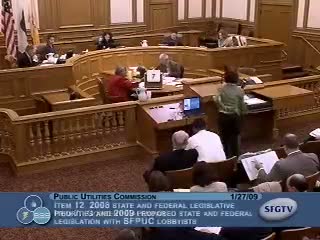
PUC hears federal stimulus timing and state legislative priorities; staff seeks changes to low‑income solar incentives
Summary
Federal lobbyist Daryl Owen and state lobbyist Don Gilbert briefed the commission on stimulus opportunities, Title 16 water programs, and pending state bills. Staff said changes to the city's GoSolar nonprofit/low‑income ordinance are being introduced at the Board of Supervisors to raise incentive levels.
The San Francisco Public Utilities Commission heard updates on federal stimulus opportunities and state legislative priorities on Jan. 27, and staff signaled changes to local solar incentive rules intended to boost nonprofit and low‑income participation.
Daryl Owen, who represents the PUC in Washington, described the stimulus as an extraordinary flow of funds and advised the commission that agencies should prioritize which projects to pursue because federal agencies may be overwhelmed with applications. He noted that the House draft was for roughly $825 billion and highlighted Title 16 water reclamation and the State Revolving Fund as likely channels for water‑related funding.
Owen urged staff to prepare complete applications and assemble matching and audit information now so the city can be competitive. He identified 525 Golden Gate as a local project with high readiness for potential federal support and said many stimulus programs will favor existing, shovel‑ready programs.
Don Gilbert, who handles state affairs, reviewed Sacramento’s budget crisis (a large multi‑billion dollar shortfall) and listed PUC state priorities: expanding city authority to install renewable generation on city property, plumbing retrofit legislation, and pursuing Proposition 84 appropriations for combined‑sewer and stormwater projects.
On solar incentives, staff said changes are being introduced at the Board of Supervisors to raise incentive levels for nonprofit and low‑income applicants and to expand eligibility, which staff said should make Espanola Jackson and others more likely to receive the higher incentive levels. Public commenters urged staff to avoid shifting $1 million from nonprofit/low‑income incentives to private mayoral programs and recommended program design changes such as per‑kW caps and city ownership/roof‑lease models to lower out‑of‑pocket costs.
Next steps: staff will continue coordinating with the mayor’s office and the Board of Supervisors on local priority lists for stimulus funding, prepare federal application materials, and pursue legislative proposals in Sacramento related to renewable installations, graywater standards and plumbing retrofits.