Get Full Government Meeting Transcripts, Videos, & Alerts Forever!
Get email alerts on the Gosolar Program topic
No spam. Unsubscribe anytime.
S.F. utilities commissioners approve streamlined GoSolarSF payments, urge more outreach to low‑income communities
Summary
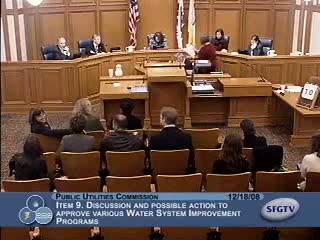
The San Francisco Public Utilities Commission voted Dec. 18 to adjust GoSolarSF payment timing, expand eligible payees and reduce some incentives while asking the Board of Supervisors to increase the low‑income add‑on and consider additional funding; commissioners added an amendment urging more aggressive outreach to low‑income and nonprofit communities.
The San Francisco Public Utilities Commission on Dec. 18 voted to revise its GoSolarSF solar‑incentive program to speed payments to applicants, allow manufacturers and distributors to receive city incentive checks, and lower some residential incentive levels while seeking Board approval to boost the program’s low‑income add‑on.
Barbara Hale, assistant general manager for power, told commissioners the program has produced roughly a 1‑megawatt increase in installed capacity since the city launched GoSolarSF in July and that applications are geographically dispersed, with one notable concentration of 47 residential applications in zip code 94110. Hale said program administrators recommend triggering payments earlier in the process to reduce installers’ cash‑flow burdens and to keep projects moving instead of waiting for California Solar Initiative confirmation.
"We'd like to be able to pay them as early as we can, while still being comfortable and confident that we have an installed system," Hale said, arguing earlier payments would prevent installers from being forced to carry multiple, delayed receivables.
Hale also proposed expanding the list of designated payees to include manufacturers and distributors so installers or component suppliers could receive the city check, giving project participants more flexibility to manage cash flow.
The staff recommended lowering several residential incentive levels because recent federal tax‑credit changes removed the prior $2,000 cap, increasing household recovery through other credits. Hale said the commission has discretion under existing municipal ordinances to reduce incentive amounts but that the low‑income add‑on — a $5,000 supplemental payment intended to offset lower federal tax‑credit value for low‑income households — requires Board of Supervisors approval.
Hale told the commission the program’s enabling ordinances set a $3,000,000 total budget split with $1,500,000 reserved for low‑income and nonprofit applicants and $1,500,000 for residential and commercial applicants. Staff reported that five months into the program roughly 83.5% of the reserved dollars are accounted for by residential and commercial applicants. Hale said about $25,000 had been paid through November, approximately $1,064,000 was reserved for pending payouts and that staff had received 23 low‑income applications with roughly $115,000 reserved for them; nonprofit reservations totaled $61,004.74.
Hale said staff proposed two possible approaches to avoid a program disruption if residential and commercial reservations exhaust the current bucket: request authority from the Board to transfer up to $1,000,000 from the low‑income/nonprofit bucket to the residential/commercial side, or ask the Board for a supplemental appropriation of $1,000,000 from the power‑for‑resale operating fund.
Public commenters representing the local solar industry urged the commission to adopt the staff recommendations. JP Ross, a member of the solar task force who said he works with Sonevity, described the GoSolarSF program as a driver of renewed installer activity and higher application volumes. Janine, co‑owner of Luminalt, said uninterrupted program operations were essential to maintaining installers’ workflow and workforce gains; she said her company had hired five San Franciscans over the past 12 months as a result of program demand.
Commissioner Speaker 9 offered an amendment asking the commission to "urge the PUC staff to more aggressively market the solar program and perform outreach to the low income and nonprofit community" before the Board considers the low‑income add‑on change. The amendment was accepted, and the commission voted to adopt the revised program changes with the outreach language added.
The adopted action authorizes the general manager to implement program changes within the commission’s discretion (for example, earlier payment triggers and expanded designated payees) and directs staff to seek Board of Supervisors action where required (notably the increase to the low‑income add‑on and any supplemental appropriation). The commission set a target implementation date of Jan. 1 for the PUC‑authorized residential incentive reductions to coincide with the new tax year, while noting the low‑income increase awaits Board approval.
Staff said some nonprofit barriers remain — notably an owner/occupier requirement that can exclude nonprofit service providers that occupy but do not own facilities — and that further Board dialogue on specific fixes may be needed.
The commission adopted the amended measure by voice vote. The commission chair adjourned the special meeting at 6:44 p.m.