Get Full Government Meeting Transcripts, Videos, & Alerts Forever!
Get email alerts on the Patrol Specials topic
No spam. Unsubscribe anytime.
Controller-funded review urges San Francisco to end city oversight of Patrol Specials, recommends interim controls
Summary
A report delivered to the San Francisco Police Commission recommended the city divest oversight of the Patrol Specials program and, in the interim, adopt measures to reduce liability and clarify roles. Commissioners asked for a written Patrol Specials response and set a follow-up timeline.
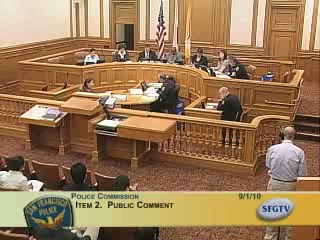
The San Francisco Police Commission on Sept. 1 heard a controller‑commissioned review that concluded the city should divest itself of formal oversight of the Patrol Specials program and treat those officers as private security, while immediately imposing interim accountability measures.
Kim Craven, who led the Public Safety Strategies Group study for the Controller’s Office, told commissioners the consultants found Patrol Specials perform services for private clients but operate outside the department’s direction and control. "Because they are paid for privately, you cannot direct their day‑to‑day activities," Craven said, and the city therefore remains exposed to liability while lacking the authority to manage those activities. The study recommended divestiture of city oversight and a transition that would move Patrol Specials into ordinary private‑security regulation while preserving their businesses.
The report also listed interim steps the commission and SFPD should take immediately if oversight remains: require distinct, non‑SFPD‑style uniforms and insignia; cease Patrol Special access to SFPD police‑channel radios and sensitive products such as the "hot sheet"; require timely proof of liability and firearms insurance and ammunition records; enforce timely sign‑in and location reporting so the department can verify where Patrol Specials are working; and tighten qualification and recordkeeping requirements.
Presenters said the study encountered limited cooperation from some Patrol Special operators, making some cost‑benefit calculations impossible. Craven said the consultants requested client lists and billing records but received only partial data; where data existed, the study found inconsistent recordkeeping and little standardized reporting that would allow the city to quantify city‑wide benefits.
Supporters of the Patrol Specials — including Patrol Special officers and neighborhood representatives who addressed the commission during a long public comment period — disputed parts of the report and pressed for preservation of the program. Alan Byron, president of the San Francisco Patrol Special Police Association, said the study contained errors and factual omissions and called it "full of mistakes and, I think, probably a few lies." Several clients and neighborhood groups said Patrol Specials provide affordable foot‑patrol coverage and rapid response for low‑priority calls that otherwise go unanswered.
Assistant Chief Jeff Godown and other SFPD officials acknowledged the Patrol Specials’ value to some neighborhoods but emphasized oversight and compliance problems documented in the study: apparent uniform and advertising practices that could confuse the public, documented incidents of Patrol Specials making arrests and using police language in ways that risk impersonation, and cases and claims that have required department time and legal defense. The Office of Citizen Complaints director, Joyce Hicks, reminded commissioners that OCC jurisdiction covers sworn SFPD personnel, not Patrol Specials.
Commissioners pressed for clarity on counts and controls: presenters said the Patrol Specials program is small relative to the city — roughly 27 active members reported in the study (nine active beat owners and 18 assistants) with many former or inactive beat owners — and that the city maintains approximately 64 beats on its historical map, though the consultants found discrepancies when counting. The consultants recommended the city expand reserve and volunteer programs as the appropriate city‑controlled alternatives for additional patrol capacity.
After public comment and commissioner questions, the commission requested a written, quantitative response from Patrol Specials addressing the report’s findings and the specific interim recommendations. Commissioners also discussed scheduling a retreat and public follow‑ups; staff and commissioners identified an Oct. 2 weekend date as a target for a retreat to set priorities and establish timelines for further action. The report is publicly available on the Controller’s Office website and was distributed to the commission.
Routine business: the commission approved minutes for past meetings earlier in the session and, at the end of the evening, voted to adjourn after continuing several disciplinary and closed‑session items to future meetings.
What’s next: the commission asked the Patrol Specials to submit a formal written reply with quantitative cost and activity data, signaled willingness to adopt selected interim controls, and moved to address the report in its retreat and at future public hearings. If the commission decides on formal rule changes, those changes would be processed through the commission’s established rulemaking practices, including OCC review and public input.
Sources: presentation and Q&A by Kim Craven and Rick Bailey (Public Safety Strategies Group) for the Controller’s Office; public comments from Patrol Special officers and clients; statements by Assistant Chief Jeff Godown and OCC Director Joyce Hicks; Police Commission discussion and scheduling notes.