Get Full Government Meeting Transcripts, Videos, & Alerts Forever!
Get email alerts on the City Budget topic
No spam. Unsubscribe anytime.
SFPD outlines deep budget gap; department says 250 layoffs would be required to hit proposed cuts
Summary
The San Francisco Police Department told the Police Commission Jan. 20 that a mayor’s-office target for up to a 30% reduction in general‑fund support could force roughly $47 million in cuts, with a 20% base reduction equating to about $31 million and a straight conversion of that figure into sworn layoffs equal to about 250 officers. City and department officials said they are pursuing alternatives but warned of severe operational consequences if deep cuts are imposed.
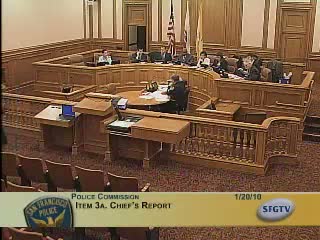
The San Francisco Police Department told the Police Commission on Jan. 20 that it faces an unusually steep budget challenge and sharply constrained choices if citywide deficit targets hold.
Ken Bukowski, the department’s chief financial officer, said the department’s FY2010‑11 base budget is about $447 million, of which roughly $362 million comes from the city’s general fund. Because roughly 90 percent of the department’s spending is for salaries and fringe, Bukowski said the mayor’s office instruction to identify a 20 percent reduction plus a potential 10 percent contingency leaves only limited nonpersonnel areas to trim. He estimated a 20 percent cut would be about $31 million and a 10 percent contingency about $15.7 million — a combined total near $47 million.
"If we needed to, if you just took the $31,000,000 and translated it roughly into the number of sworn layoffs, it would be somewhere in the neighborhood of 250 officers," Bukowski said in response to a commissioner question. Department officials and commissioners cautioned that such a loss, combined with expected retirements over the next three to four years, would risk serious disruptions to public safety and would be difficult to staff back up later.
Commissioners asked about measures such as station consolidation, which have been floated in independent studies as a long‑term cost option. Bukowski and other department leaders said consolidating stations is unlikely to produce near‑term savings because suitable facilities are not available and the initial capital and facility costs would offset personnel savings in the short run. The department said consolidation might become financially sensible only when evaluated over a multi‑year horizon.
Bukowski outlined where the department could look for savings without layoffs: permanent reductions in overtime (the mid‑year reduction produced about $3 million, and further reductions might yield $3–5 million annually), attrition if academy classes were limited, and trimming contracts and nonpersonnel services. He said those avenues could produce meaningful but insufficient amounts compared with the $31 million target.
Commissioner James Hammer pressed department leaders on the trade‑offs, saying slower discipline or investigation timelines — an indirect effect of cuts elsewhere — could carry their own public‑safety costs if officers spent extended periods on light duty pending case resolution. Chief speakers reiterated that the department would prioritize avoiding sworn layoffs if at all possible but that the scale of the targets makes that difficult.
The commission will receive a detailed draft budget at its Feb. 10 meeting and a final version on Feb. 17 ahead of the city’s submission deadlines.