Get Full Government Meeting Transcripts, Videos, & Alerts Forever!
Get email alerts on the Crime Lab Dna topic
No spam. Unsubscribe anytime.
Police commission schedules policy review after DNA lab update that shows limited staffing and backlog distinctions
Summary
Commander David Lazard told the commission the SFPD DNA unit has one supervisor and six analysts, with 28 sexual‑assault cases actively worked and the department defining 'backlog' as unassigned cases. Commissioners set an Oct. 6 agenda for possible revisions to general orders on sexual‑assault/DNA testing.
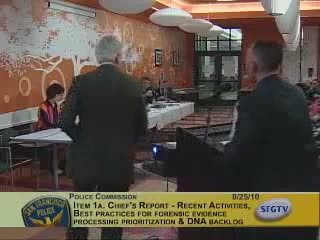
Commander David Lazard, the department official overseeing forensic biology, told the San Francisco Police Commission on Aug. 25 that the SFPD crime laboratory’s DNA section currently has one supervisor and six analysts and is handling 28 active sexual‑assault investigations while another set of cases is under technical review. "There are 28 sexual‑assault cases that are being worked on in the lab," Lazard said during the commission’s community meeting in the Tenderloin.
Commissioners focused on staffing, backlog definitions and turnaround times as central to victim‑service outcomes. Lazard said the department defines a backlog as cases that are unassigned to an analyst or not yet contracted out; by that definition he reported three backlog cases and said there were no homicide backlog cases. "An open case is an unsolved case," Lazard explained, distinguishing operational definitions that previously caused inconsistent public reporting.
Lazard provided comparative turnaround benchmarks and current targets spelled out in Department Bulletin 10‑054: an "immediate" request (worst‑case 4–6 weeks), "priority" (about eight weeks), and "routine" (three to four months). He compared SFPD’s current ranges (reported in presentation materials as roughly 60–120 days for certain sexual‑assault work) with other regional labs and said best practices call for prioritizing stranger‑suspect cases.
The commander described recent contracting to outside vendors to relieve capacity constraints: as of the briefing he said the department had contracted out work on a reported 30 gun‑DNA cases and 11 sexual‑assault cases. He also said the city has issued a request for qualifications (RFQ) to identify additional outside providers and was about one month into a six‑month procurement process.
Commissioner James Hammer pressed the department for a policy focus on rapid handling of unknown‑assailant sexual‑assault cases; Hammer and other commissioners emphasized that a timely turnaround can produce hits in the CODIS database and reduce recidivism. Lazard confirmed the department would research whether an older grant‑funded program (ASAP), which once expedited samples to an external lab, could be revived.
The commission agreed to calendar a public hearing and potential action on relevant Department General Orders concerning sexual‑assault testing and DNA protocols for Oct. 6, directing staff to circulate supporting materials well in advance so commissioners can assess proposed revisions and any meet‑and‑confer or procurement implications. The Oct. 6 item was described as "discussion and possible action" so that the commission could consider draft changes and next steps.
Next step: the commission will receive written materials from the department and lab leadership before the October agenda item; the commission requested clarity on the age and prioritization of any untested stranger‑assault cases and on the status of the RFQ and interim contracting arrangements.