Get Full Government Meeting Transcripts, Videos, & Alerts Forever!
Get email alerts on the Medicinal Marijuana topic
No spam. Unsubscribe anytime.
SFPD outlines medical-marijuana enforcement plan, seeks permitting, registry and more training
Summary
The San Francisco Police Department told the Police Commission it aims to balance patients’ lawful access with public-safety concerns, proposing interagency permitting and a grower registry, expanded officer training and security outreach to dispensaries. Advocates pressed for protections to avoid seizing patients’ medicine.
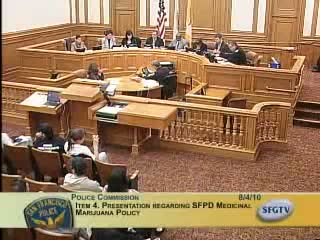
Commander John Loftus, commanding officer of the San Francisco Police Department’s Investigations Bureau, told the Police Commission on Aug. 4 that the department’s goal is to "ensure the qualified patients have safe and legal access to their medicine." He updated commissioners on recent interagency meetings and on SFPD enforcement activity related to dispensaries and indoor cultivation.
Loftus said the department has seen a surge in dispensary applications and has offered security training to the city’s 22 medical cannabis dispensaries. "There have been no reported incidents at any medical cannabis dispensaries in San Francisco since we last met," he said. He added that the department will send a letter to dispensaries offering security inspections and training.
The presentation focused heavily on residential cultivation and safety risks. Loftus described three cultivation types — individual patient gardens, collectives and commercial nurseries — and said the city’s ordinance allowing 24 plants per qualified patient can yield much larger totals when multiple patients are associated with a collective. He flagged illegal electrical work, overloaded circuits, ventilation ducting and improper irrigation and plumbing as causes of fires and environmental risk, and described recent illegal residential operations that prompted police action.
Commissioners and the public pressed the department for clarity on how it distinguishes lawful compassionate growers from illegal commercial operations. One commissioner said the presentation’s photos could unfairly conflate legitimate medical growers and illegal operations; Loftus replied that most of the photographs in the packet were taken during narcotics follow-ups of illegal grows but offered to identify the origin of each photo and pointed the commission to annexes in the packet with more detail.
Loftus also described steps the department is taking on training and internal policy. He said about 10 officers recently were assigned to narcotics and completed an 80-hour state narcotics investigators course; some officers also took a voluntary 16-hour DOJ cultivation course. Officers are instructed by department bulletin to contact supervisors, narcotics or the legal division before taking enforcement action in cases where medical-marijuana defenses may apply.
On next steps, Loftus recommended moving toward an interagency approach to permitting and a voluntary grower registry that would involve the Department of Public Health, Department of Building Inspection and the Planning Department. "What we're hoping to move forward to is some type of permitting process very much like when you attempt to remodel your kitchen," he said, describing inspections and sign-offs that would deem an operation safe and legal.
Public commenters representing patient collectives, advocacy groups and neighborhood associations urged greater protections for patients and standardized documentation for collectives. Stuart Rhodes, who chaired a cultivation subcommittee, urged civil remedies — building inspections and fix-it notices — instead of criminal seizures where public-safety risks do not exist. Speakers described multiple raids in particular neighborhoods and asked for monthly SFPD-community meetings, a voluntary registry to reduce unnecessary seizures and clearer paperwork standards for collectives.
The commission did not vote on new policy at the meeting but asked the department to continue interagency work. Loftus said he would meet next week with building, planning and public-health officials to pursue the registry and permitting approach, and that the department planned to update its bulletin after the November ballot developments. The commission closed the item after extensive public comment; commissioners signaled interest in a future follow-up presentation that would separate issues affecting lawful, compassionate growers from illegal operations.
The Police Commission is scheduled to revisit related training and policy material after the election and as the department and advocacy groups provide proposed registry or permitting frameworks.