Get Full Government Meeting Transcripts, Videos, & Alerts Forever!
Get email alerts on the Water Conservation topic
No spam. Unsubscribe anytime.
SFPUC urges Board of Supervisors to require fixture retrofits on resale to conserve water
Summary
The San Francisco Public Utilities Commission voted to urge the Board of Supervisors to adopt ordinances updating the housing and building codes to require water‑efficient fixture retrofits on resale and staged retrofit triggers for commercial buildings; staff said the change targets pre‑1995 units and could save more than 20 gallons per unit per day compared with older fixtures.
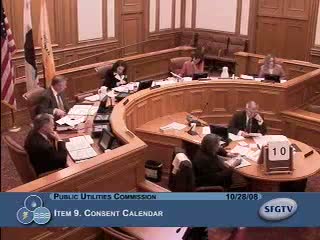
The San Francisco Public Utilities Commission voted Oct. 28, 2008, to send a resolution to the Board of Supervisors urging ordinances that would update the city’s residential and commercial codes and require retrofit of older plumbing fixtures when a unit or building is sold or substantially renovated.
Laura Spangen, head of external affairs for the SFPUC, said the draft measures would amend chapter 12a of the housing code and chapter 13a of the building code to replace outdated efficiencies (the current text still references 3.5‑gallon toilets) with modern standards (for example, 1.6‑gallon toilets) and to require upgrades to toilets, showerheads and faucets in pre‑1995 units.
Spangen said staff and stakeholders negotiated compromise language intended to reduce the immediate burden on commercial building owners: retrofit triggers could include major floor renovations or a staged requirement that would take effect within roughly 5–7 years for existing commercial stock. On the residential side, staff highlighted that more than 200,000 units predate 1995 and said early analysis shows older units typically use about 59–60 gallons per person per day versus about 50 gallons per person in post‑1995 buildings — roughly a 20‑gallon per unit difference on average.
Public comment supported the commission’s action. Jennifer Clary, a policy analyst with Clean Water Action, told commissioners the bill had been tried in previous years and urged adoption now; Clary also said the SFPUC Citizens Advisory Committee voted unanimously to support the proposal.
Commissioner discussion focused on timing and compliance triggers. Staff said they had worked with building owners and the city attorney on hybrid language that would allow retrofit triggers on renovations and also a time‑based backstop for commercial properties, while seeking an acceptable compromise on the residential side.
A commissioner moved to approve the resolution urging the Board of Supervisors to enact the two ordinances; the motion was seconded and carried on a voice vote.
The SFPUC’s action is advisory — final ordinance language and any compliance deadlines will be set by the Board of Supervisors. The commission asked staff to continue stakeholder engagement and carry forward the package to the board for consideration.