Get Full Government Meeting Transcripts, Videos, & Alerts Forever!
Get email alerts on the Secure Communities topic
No spam. Unsubscribe anytime.
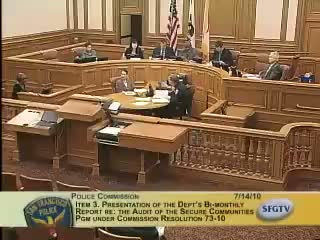
Police commission hears audit of Secure Communities; department says SFPD does not enter ICE's civil warrants into local NCIC/CLET
Summary
The San Francisco Police Commission received a department audit showing 122 ICE-SCOM matches in the sampled period and heard staff say SFPD policy prohibits officers from asking immigration status or enforcing ICE administrative (civil) warrants except in limited, emergency circumstances. Commissioners asked staff to verify whether ICE administrative warrants ever appear on officers's NCIC/CLET screens and requested a department bulletin and refresher training.
The San Francisco Police Commission on July 14 received its first bimonthly audit of the federal Secure Communities (S-Comm) fingerprint-sharing program and urgent clarification of how the department handles civil (administrative) immigration warrants.
Captain David Lazar of the SFPD operations bureau told the commission that the city's sanctuary policy and department general orders prohibit officers from asking about a person's immigration status or detaining someone solely to determine status. "No city resources and city funds are to assist in enforcement unless assistance is required by federal or state statute, regulation, or court decision," Lazar said, summarizing departmental guidance and the city's sanctuary policy dating to 1989.
Gordon Brusso, SFPD's identification manager, presented the audit figures compiled for the commission under Resolution 73-10. Brusso said the SFPD recorded 1,655 live scans in the sample period and that ICE reported 122 S-Comm matches back to the department. Of those matches, the SFPD categorization used ICE's level system: 73 level-1 matches, 38 level-2 and 11 level-3 matches, Brusso said. He cautioned that differences in agency systems and timing make direct comparisons with sheriff's records difficult: "These are different universes," he told commissioners, noting some requested items were not administratively feasible to collect.
Commissioners pressed staff to clarify the operational effect of a match in the field. Lazar and chief command staff said police officers will act on criminal warrants that appear in NCIC/CLET: if a criminal warrant appears on an officer's screen they will detain the person and contact the Central Warrant Bureau for confirmation. But Lazar and the warrant unit told the panel that ICE's administrative (civil) warrants generally reside in ICE's own system and are not entered into local NCIC/CLET files, so a routine warrant check by an SFPD patrol officer would not show those civil warrants. Lazar recommended further verification with the sheriff's warrant bureau and ICE and said the department will follow up in writing.
Commissioner Angela Chan asked for a written letter and a department bulletin summarizing the presentation for patrol officers; Commissioner James Hammer and others urged refresher training so officers in the field understand what to do if a warrant appears on their screen. Chief George Gascon and staff agreed to provide additional verification and to work with the sheriff's office to confirm whether administrative warrants can surface on the screens officers access in patrol vehicles.
Members of the public and community advocates who spoke during the item's public comment period welcomed the audit but warned that S-Comm can chill reporting by crime victims and witnesses. Francisco Garth of Dolores Street Community Services said national data suggest a majority of S-Comm matches are for lower-level offenses and urged ongoing monitoring to detect racial profiling and impacts on victims, especially survivors of domestic violence.
Formal actions taken during the meeting included the commission's vote to issue police-commission subpoenas in two disciplinary matters (so ordered) and a vote to maintain non-disclosure of closed-session deliberations (so ordered despite objection). The commission also moved into closed session on several personnel and disciplinary items and reconvened to accept the reports and public comment.
What's next: commissioners asked the department to report back with definitive verification about whether ICE administrative warrants ever appear on officer NCIC/CLET screens, to share any draft department bulletin with the commission, and to outline a plan for refresher training for patrol staff. The commission also scheduled continued oversight through the bimonthly S-Comm audit.
(Reporting based on San Francisco Police Commission meeting transcript, July 14, 2010.)