Get Full Government Meeting Transcripts, Videos, & Alerts Forever!
Get email alerts on the Crime Stats topic
No spam. Unsubscribe anytime.
Police Commission hears midyear crime report showing sustained multi‑year declines
Summary
At the July 21 meeting the San Francisco Police Commission heard midyear crime statistics from Chief George Gascon showing a 20% reduction in Part I crimes compared with two years earlier and modest declines year‑to‑date. Commissioners asked for follow‑up briefings and endorsed continued reforms in community policing and data systems.
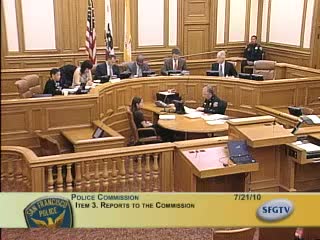
The San Francisco Police Commission on July 21 heard midyear crime statistics from Chief of Police George Gascon that showed significant multi‑year declines in serious crimes and continued modest year‑to‑date decreases.
Chief Gascon told the commission the department’s year‑to‑date comparison against 2008 showed a roughly 20% reduction in Part I crimes and cited a change in the city’s approach—deploying officers based on statistical analysis and a zone strategy—as a key factor. “We’re talking about over 4,400 less crimes today than two years ago,” Gascon said, adding that the reductions translate into fewer victimizations across the city.
The chief also noted that homicides remained low: “Year to date, we’ve had 26 homicides. Last year today, we had 27,” he said, and cautioned that short‑term fluctuations are possible. Gascon said the department is improving its data and technology capacity—combining ComStat with new record management tools—and credited community police advisory boards and district captains for part of the progress.
Commissioners pressed for concrete next steps and oversight. Commissioner James Hammer thanked staff for recent lab and field visits and asked the department to return with a detailed plan on laboratory and operational fixes. Several commissioners supported continuing the commission’s regular progress briefings so that members and the public can track whether recent reductions become a stable trend.
The meeting record shows the commission accepted the report and scheduled follow‑up briefings on related items; no formal policy vote was taken during this presentation.