Get Full Government Meeting Transcripts, Videos, & Alerts Forever!
Get email alerts on the Secure Communities topic
No spam. Unsubscribe anytime.
Police Commission votes to audit local impact of Secure Communities program
Summary
The San Francisco Police Commission unanimously approved a resolution on June 23, 2010, directing the San Francisco Police Department to audit how the federal Secure Communities program is affecting arrests, detainers and different communities in the city. The resolution asks for regular reports and cross‑agency cooperation with the sheriff’s office.
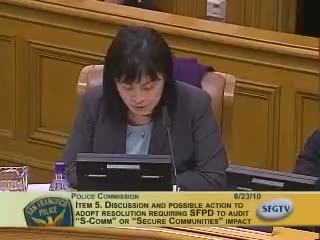
The San Francisco Police Commission on June 23 unanimously adopted a resolution directing the San Francisco Police Department to audit the local impact of the federal Secure Communities program.
The resolution, amended at the meeting, asks the department to collect and report aggregate data on matches returned by Secure Communities, including charge-level breakdowns (level 1, 2 and 3), age categories (juvenile/adult), and aggregate race data for individuals identified as matches. It also asks the department to request and include, where administered by the sheriff’s office, information about ICE detainers, releases to ICE and length of holds. The commission set a reporting schedule that begins July 14, 2010, and requires bimonthly updates thereafter.
“Secure Communities has been imposed on San Francisco without clear information on its local impact,” Commissioner Angela Chan said when she read the amended resolution into the record. The amendment removed a clause about federal ownership of fingerprint data and made language about citizenship and language collection conditional on legal constraints and administrative feasibility.
SFPD’s identification manager, Gordon Bridal, told the commission what data the department receives through LiveScan. Bridal said some items the commission requested—such as detainer notices and the exact time held prior to pickup—are maintained by the sheriff’s booking system rather than SFPD and will require interagency coordination to include in the audit. He said LiveScan reliably provides charge codes and date of birth but that fields such as primary language and place-of-arrest are not consistently completed and therefore may be included only “if administratively feasible.”
Chief George Gascon told commissioners the department would collaborate with the sheriff’s office and assign staff to work across agencies to assemble the requested information. “We’ll put our people and your people around the table and figure out how this would actually flow,” he said.
Immigration attorney Francisco Ugarte, speaking during public comment on behalf of a nonprofit coalition, urged the commission to proceed. “The minimal thing the commission can do is simply to keep information about who’s being deported from the city,” Ugarte said, noting the Board of Supervisors and other local bodies have expressed concern about Secure Communities.
Commissioners debated several technical and legal points before voting, including whether the Vienna Convention or state law requires collection of country-of-citizenship fields and whether ZIP code is an acceptable proxy for place of arrest when district-level aggregation would require programming changes. City attorney staff agreed to review legal points and staff emphasized flexibility in implementation: data elements that proved infeasible would be reported back with an explanation.
The motion to adopt the resolution as amended passed on a roll-call vote: de Jesus — aye; Chan — aye; Hammer — aye; Marshall — aye; Mazzuco — aye.
The commission asked the chief to report back with the first audit on July 14 and to provide bimonthly updates thereafter. If parts of the request proved administratively burdensome, the department was to notify the commission and propose adjustments.