Get Full Government Meeting Transcripts, Videos, & Alerts Forever!
Get email alerts on the Energy Efficiency topic
No spam. Unsubscribe anytime.
SFPUC unveils $1.86M program to audit municipal energy use, touts grease-collection effort and regional water savings
Summary
Assistant General Manager Barbara Hale outlined a $1,860,000 General Fund energy-efficiency program targeting facility audits and retrofits, noted a mayoral 5% energy reduction target and a 25% funds-withholding incentive, and staff highlighted a grease-cycle program that collected over 100,000 gallons of used cooking oil along with a regional Water Saving Heroes campaign reporting 13% voluntary water-use reductions.
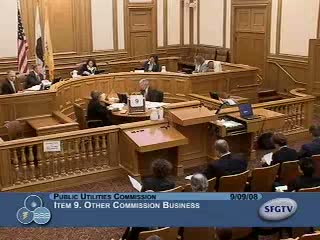
At the Sept. 9, 2008 meeting the San Francisco Public Utilities Commission received a general manager’s report highlighting energy-efficiency and water-conservation initiatives.
Ed Harrington, general manager, opened by noting program priorities and introduced the award for the grease cycle program. Staff said the grease collection effort has hand-collected over 100,000 gallons of used cooking oil from about 500 restaurants, hotels, schools, hospitals, churches and other generators to prevent sewer system impacts. Bruce Wolf, executive director of the Regional Water Control Board, presented a preliminary pollution-prevention certificate and praised the PUC’s efforts.
Barbara Hale, assistant general manager for Power, briefed the commission on a General Fund Energy Efficiency program that received a $1,860,000 allocation to target energy audits at municipal facilities with energy bills over $10,000 per year. Hale described a suite of services the Energy Efficiency Services Group provides — energy audits, project financing functions, retrofit design and construction management, and measurement and verification — and said the program will prioritize measures that yield rapid savings. "We provide energy audits, we, perform project financing functions, retrofit design, we perform project management, construction, design review, and then we measure and verify the savings that we had projected," she said.
Hale noted several implementation points: the city’s municipal green building ordinance requires new municipal construction to meet LEED Silver and exceed California Title 24 energy-code requirements; the PUC will start a quarterly energy report to show consumption at the facility level; and the mayor’s March 2008 executive directive sets a 5 percent energy-reduction target for the fiscal year. Hale said the mayor’s budget office is withholding 25 percent of the energy portion of department budgets and will release those funds when departments demonstrate project progress.
Hale also highlighted existing and pilot projects: lighting retrofits in DPW tunnels, audits at police and fire facilities, and a pilot streetlight LED change-out in the Civic Center around the Asian Art Museum and main library. For the airport, staff estimated potential savings of 37,000,000 kilowatt-hours per year if identified measures are implemented.
On water conservation, staff reported that the Water Saving Heroes regional outreach campaign (a partnership of ten agencies) leveraged $1 million in agency funds and an additional match from the Department of Water Resources. Staff said voluntary regional water users achieved a 13 percent reduction in water use from the base year and that PSAs (including ethnic-language spots) would run in September and October.
Commissioners asked about compact fluorescent bulb disposal (mercury handling); Hale explained proper disposal procedures and education efforts. Commissioners also asked about LED signals and streetlight pilots; Hale said signal conversions are mostly complete and streetlight LED pilot installations are being evaluated.
The commission welcomed the report and scheduled follow-up updates on program progress and kilowatt-hour savings.