Get Full Government Meeting Transcripts, Videos, & Alerts Forever!
Get email alerts on the Homelessness topic
No spam. Unsubscribe anytime.
City presentation details shelter capacity, but disability advocates press for more accessible options
Summary
Department of Homelessness and Supportive Housing presented shelter and navigation-center capacity and accessibility policies; council members and public commenters pressed the department for clearer procedures for people who cannot 'self‑care,' better 311 access for deaf residents, and more outreach to unsheltered people with disabilities.
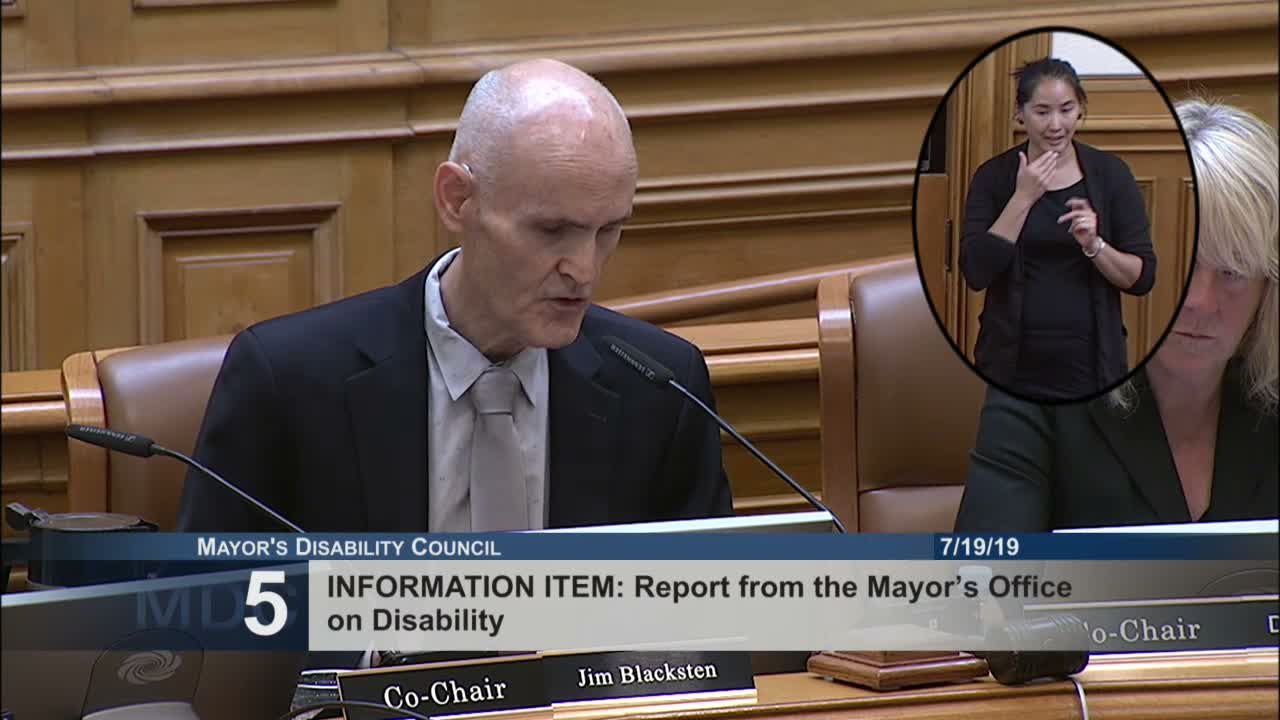
Scott W. Walton, manager of Navigation Centers and Shelter Programs at the Department of Homelessness and Supportive Housing, told the Mayor’s Disability Council on July 19 that San Francisco operates nine adult emergency shelter sites with about 1,203 sleeping spaces and five navigation centers housing roughly 494 beds.
Walton said placement into shelters is done by reservation through 311 and the city’s coordinated‑entry process, which assesses people’s vulnerability and barriers to housing. He described a strategic framework backed by Mayor Breed that aims to add 1,000 shelter beds and 500 permanent supportive housing units by the end of 2020 and to consolidate multiple program databases into a single system to improve referrals and placement.
The presentation included specific accessibility practices: Walton said roughly 574 beds are accessible 24 hours a day, another portion of beds are accessible 'much of the day,' and some sites are only available overnight due to physical constraints. He said shelters generally require that residents be able to self‑care, but that attendants or in‑home support services workers may accompany and assist clients when appropriate. Walton said the department coordinates with the Department of Public Health and other city agencies when cases require higher levels of medical or in‑home care.
Council members and public commenters pressed for more details. Council member Alex Madrid asked whether people who need help with wound care or medication are automatically denied shelter; Walton said staff try case‑by‑case solutions, may call 911 when a medical emergency is suspected, and rely on DPH to assess whether hospital or higher‑level care is needed. Walton acknowledged some shelters lack elevators or ground‑floor access and said the department is trying to make sites fully accessible when building or rehabbing facilities.
Public comments raised procedural and equity concerns. Zach Karnazes, calling on the bridge line, said recurring technical problems with the call‑in system and late agenda notices limit participation; he also urged MOD to coordinate tree‑removal notifications for people with visual impairments. A Faithful Fools speaker described people losing medications and possessions during street sweeps and urged more police training and better property‑retrieval conditions.
Walton described operational rules on service and companion animals, saying navigation centers are generally low‑threshold and often allow pets when space and safety permit; for aggressive animals the owner is first warned and the department may require that the animal be removed while preserving the person’s shelter reservation when possible. He emphasized training introduced in 2010 and ongoing coordination with MOD to reduce complaints and improve provider response to accessibility requests.
The council directed staff to follow up with the department on communication improvements (adding TTY and other access information to 311 outreach), clearer messaging about coordinated entry for people with disabilities, and additional engagement around in‑home support services and outreach to unsheltered populations.
The council did not vote on specific policy changes during the meeting; Walton said items not covered would be addressed in future follow‑up.