Get Full Government Meeting Transcripts, Videos, & Alerts Forever!
Get email alerts on the Water Supply topic
No spam. Unsubscribe anytime.
PUC urges voluntary 10% water conservation after dry months; Hetch Hetchy near 86% of capacity
Summary
Assistant GM Michael Carlin told the PUC that Hetch Hetchy storage rose to about 310,000 acre-feet and staff recommends a voluntary 10% conservation campaign for customers amid a dry year and a 50% chance of falling below Level 1 rationing by July 1.
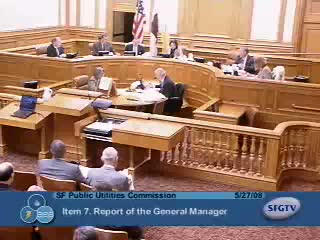
At the May 27, 2008 meeting of the San Francisco Public Utilities Commission, Michael Carlin, Assistant General Manager for Water, reported regional water conditions and urged voluntary conservation.
Carlin said Hetch Hetchy Reservoir has a capacity of about 360,000 acre-feet and was at roughly 310,000 acre-feet at the time of his report, up from lower levels after recent precipitation. He described this water year as ‘‘about a 70% year’’ and noted that March and April had been unusually dry, which depressed storage. Carlin said staff expects to approach roughly 340,000 acre-feet in mid-June and expressed cautious optimism because recent storms and mountain snow improved inflows.
Explaining entitlements and inflow, he emphasized that district entitlements receive priority and that the PUC credits entitlements to the system when unimpaired flows exceed the entitlement threshold. On the probability of shortages, Carlin presented analysis showing about a 50 percent chance that regional storage could fall below Level 1 rationing targets by July 1 under current conditions and recommended asking customers for a voluntary 10 percent reduction in use. "We want to go to voluntary conservation of 10% again this year," Carlin said, adding that last year customers achieved roughly 12 percent reductions compared with a prior dry year.
Carlin asked the commission to coordinate communications with wholesale customers through the Bay Area Water Supply and Conservation Agency to drive system-wide conservation. Commissioners thanked him for a clear presentation and had no objections to proceeding with the voluntary campaign.
Next steps: staff will coordinate a regional conservation message and track consumption trends; if conditions worsen, the commission and staff can revisit mandatory measures or higher-level triggers defined in water-conservation plans.