Get Full Government Meeting Transcripts, Videos, & Alerts Forever!
Get email alerts on the Low Impact Development topic
No spam. Unsubscribe anytime.
SFPUC outlines low-impact development plan, models 400–700 million gallon runoff reduction
Summary
At the May 13 SFPUC meeting, wastewater planner Rosie Jenks presented the commission with a low-impact development strategy that she says could reduce stormwater runoff by roughly 400–700 million gallons per year and proposed short-, mid- and long-term incentives including small grants, flow-factor adjustments and possible impervious-surface fees.
Rosie Jenks, a wastewater planning and regulatory compliance specialist at the San Francisco Public Utilities Commission, told commissioners May 13 that a citywide low-impact development (LID) approach could cut runoff by an estimated 400 to 700 million gallons annually if elements such as eco-roofs, disconnected downspouts and bioretention planters were widely adopted. "We estimated that it would reduce runoff by about 400 to 700,000,000 gallons per year," Jenks said while outlining modeling scenarios.
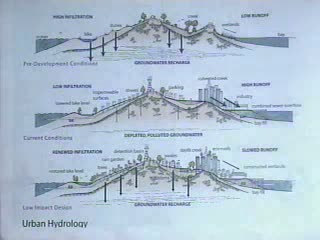
Jenks described LID as a set of techniques that reintroduce predevelopment hydrology into urban areas through features such as green roofs, pervious paving, vegetated swales, street trees and rain-harvesting. She said federal and local regulations are driving the work: the Environmental Protection Agency requires LID measures in separated sewer areas and the mayor's green building ordinance will require stormwater management on private projects greater than 5,000 square feet.
The presentation included modeled examples used to estimate benefits: 1,000 eco-roofs, 100,000 street trees, 1,800 disconnected downspouts, bioretention planters on 100 city blocks and converting 60 parking lots to permeable paving. Jenks said the modeling was generalized and that strategically placing measures where they are needed most would yield greater system benefits.
Jenks acknowledged several practical obstacles. Current wastewater rates are based on potable-water consumption, a structure that hides the true cost of stormwater collection and treatment and makes rate-based incentives difficult. "We don't currently meter the contribution to the sewers," she said, noting that the PUC's flow-factor adjustment and other tools could be expanded but that no long-term funding source for staffing and incentives has been identified.
To pilot neighborhood-scale work, Jenks said the PUC planned a $100,000 community-challenge grants program to award five $20,000 grants for streetscape retrofit projects and noted a $400,000 partnership with the school district funded by a supplemental environmental project. The PUC will also explore rain-barrel giveaways and rebate programs and coordinate guidance with the Department of Public Health to address vector control issues.
Commission discussion focused on priorities and cost-effectiveness. One commissioner urged concentrating on the largest-impact elements, such as rooftop disconnects and cisterns, rather than lower-impact measures like permeable parking lots. Jenks said the city is participating in the Better Streets Plan and developing a Stormwater Design Guidebook to guide developers and project review.
The commission welcomed the update and asked staff to return with implementation details and to coordinate the program's funding and oversight responsibilities with the upcoming sewer system master plan and rate study. The PUC did not take formal action at the meeting; Jenks said staff would seek direction and feedback as planning proceeds.