Get Full Government Meeting Transcripts, Videos, & Alerts Forever!
Get email alerts on the Energy Generation Peakers topic
No spam. Unsubscribe anytime.
SFPUC officials send peaker-plant package to mayor amid community protests; commissioners ask staff to add contract 'delete' option
Summary
The San Francisco Public Utilities Commission reported delivery of a legislative package for new combustion-turbine 'peaker' units to the mayor’s office and, after public comment and commissioner debate, directed staff to explore including a contract 'delete' or relocation alternate for the airport unit without delaying the mayoral submission.
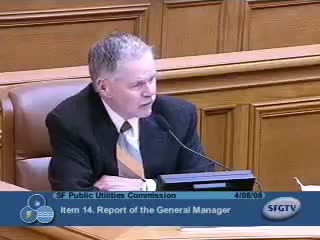
The San Francisco Public Utilities Commission told the mayor’s office this week that staff had delivered a legislative package to enable construction of a set of combustion turbines intended to replace an older generating facility, setting off renewed public opposition and a commission request for contract flexibility. "We did provide the mayor's office with a legislative package, which included the construction contract as well as, all the other agreements that we feel would require Board of Supervisors' approval to move forward with construction," Mike Martin of the SFPUC said during the General Manager's report.
Community members from Bayview-Hunters Point, Potrero Hill and other neighborhoods pressed the commission in a prolonged public-comment period to pause the proposal, demand an independent review of California ISO (Cal ISO) reliability assumptions, and hold more hearings in affected neighborhoods. "We're looking to your new leadership to stop this runaway power plant freight train," Joshua Arce, executive director of the Brightline Defense Project, told the commission.
Commissioner Sklar raised a procedural and substantive concern about one of the four proposed turbines: he said the fourth unit, sited at San Francisco International Airport, is costlier per megawatt and may not be necessary for regional reliability. He urged adding a "delete alternate" or an option to relocate the airport unit to the in‑city site so the city could avoid building an unnecessary installation if Cal ISO or other developments reduce the requirement. "I don't believe the airport unit is needed for reliability," he said, urging staff to preserve contract flexibility without slowing the legislative timeline.
Assistant General Manager for Power Barbara Hale responded that Cal ISO's action plan and subsequent correspondence indicate the city needs replacement capacity. "I think what you've stated, Commissioner Sklar, is correct," she said while explaining that locational capacity requirements and proximity to gas and transmission lines influenced site evaluations.
General Manager Ed Harrington and other commissioners framed the staff action as implementing prior policy decisions by the commission, the mayor and the Board of Supervisors, and said the package is now with the mayor’s office, which may introduce it to the Board of Supervisors. Harrington said the staff can return a revised item to the commission if the mayor or supervisors request changes.
The commission did not take a formal vote to rescind or amend the package at the meeting. Instead, commissioners expressed a "sense" direction to the general manager and staff to pursue contract language that would allow the airport unit to be deleted or moved (a nonbinding direction to explore options that staff may include in procurement documents) while maintaining the overall schedule. Commissioners also reiterated repeated requests that Cal ISO confirm, in writing, whether fewer turbines could meet the reliability need before any further local action.
The public record at the meeting shows strong community concern about health and cumulative pollution impacts in southeast neighborhoods and a demand for additional, neighborhood‑based hearings and documentation of the need for CT capacity. Several speakers urged the Board of Supervisors to scrutinize the contract when it reaches that body or to send the item back to the commission for further review.
Next steps: staff will provide commissioners with the legislative package documents (they were delivered to the mayor’s office), and the general manager said he would work with the mayor’s office and staff to seek opportunities to include the suggested contract alternates without delaying the mayoral submission. If the mayor introduces the package at the Board of Supervisors, that body will have the legal authority to approve or request changes.