Get Full Government Meeting Transcripts, Videos, & Alerts Forever!
Get email alerts on the Environmental Justice topic
No spam. Unsubscribe anytime.
Community groups press SFPUC for environmental‑justice policy, caution on Tuolumne diversions
Summary
Multiple community organizations and the Citizens Advisory Committee urged the commission to adopt environmental‑justice guidelines, prioritize outreach and public participation in WSIP, and to avoid tying increased Tuolumne River diversions to infrastructure upgrades.
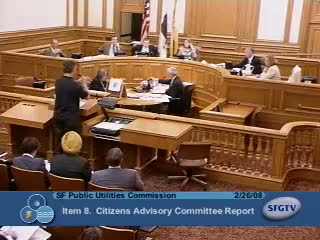
Speakers during the Feb. 26 public‑comment period urged the San Francisco Public Utilities Commission to take stronger steps on environmental justice and to separate water‑diversion proposals from seismic upgrade approvals.
Peter Drechmeyer, Bay Area Program Director for the Tuolumne River Trust, representing a coalition that includes Clean Water Action, the Environmental Defense Fund and the Sierra Club, presented a position paper urging the commission to decouple a proposal that would allow up to 25,000,000 gallons per day of additional diversion from the Tuolumne River from the WSIP seismic upgrades. Drechmeyer said the river — designated Wild and Scenic in 1984 and a key tributary to the San Joaquin system — already experiences average diversions of about 60% of natural flow and up to 90% in dry years, and that further diversion would exacerbate declines in Chinook salmon and steelhead populations.
Laurie Schumann, speaking for the Citizens Advisory Committee (CAC), summarized the CAC’s advice to the commission, including a recommendation to adopt an environmental‑justice working policy and convene a technical advisory committee to develop permanent guidance. Schumann asked the commission to facilitate public participation in the WSIP environmental‑impact process and urged adoption of pilot projects demonstrating environmental‑justice principles.
Francisco de Costa, a local resident, framed the water system in spiritual and cultural terms and urged regular reporting on large losses he said are occurring through the system’s pipes. Joseph Brian of the A. Philip Randolph Institute asked the commission to adopt environmental‑justice guidelines and factor affected neighborhoods into infrastructure siting decisions.
Commissioners acknowledged these concerns and directed staff to continue public outreach and stakeholder engagement as WSIP revisions proceed.