Get Full Government Meeting Transcripts, Videos, & Alerts Forever!
Get email alerts on the Public Space Regulation topic
No spam. Unsubscribe anytime.
San Francisco Police Commission hears wide debate over proposed citywide "sit‑and‑lie" ordinance
Summary
The Police Commission hosted an extended presentation and public comment on a proposed citywide sit‑and‑lie ordinance that would bar sitting or lying on sidewalks between 7 a.m. and 11 p.m.; police argued it would let officers address obstructive behavior proactively, while civil‑liberties groups and neighborhood advocates warned of broad, discriminatory impacts and urged more data and narrower drafting.
The San Francisco Police Commission heard a lengthy presentation and public comment on March 10 about a proposed citywide "sit‑and‑lie" ordinance that would make it unlawful to sit or lie on public sidewalks from 7 a.m. to 11 p.m. Assistant Chief Casper, presenting the department’s proposal, described exceptions and enforcement procedures and emphasized warnings before citations.
The ordinance as presented would ‘‘make it unlawful to sit or lie on a public sidewalk’’ during the stated hours but would exempt medical emergencies, permitted activities, wheelchairs, strollers and city benches, Assistant Chief Casper said. He added that ‘‘no one shall be cited without first receiving a warning’’ and that the department’s objective is behavior change, not mass arrests. The department also told commissioners it modeled the proposal on a Seattle ordinance that survived Ninth Circuit review and that it would provide ‘‘a biannual report to the Board of Supervisors on the sit‑and‑lie enforcement.’’
Why it matters: supporters — including merchants and some neighborhood groups — say a narrowly tailored tool would let officers intervene earlier in locations where merchants and residents report aggressive congregations, threats and sidewalk obstruction. Opponents — led by civil‑liberties and homeless‑rights advocates — warned the draft is overly broad and risks criminalizing ordinary and protected activities such as peaceful panhandling, sitting while awaiting transit, or day‑laborers resting while seeking work.
Alan Schlosser, legal director of the American Civil Liberties Union of Northern California, told the commission the draft ‘‘criminalizes innocent conduct’’ and compared it to vagrancy or loitering laws with a high risk of arbitrary enforcement. Lara Hurtado of the Lawyers Committee for Civil Rights said the proposal ‘‘would make it illegal’’ for a broad range of people — from a child selling cookies on a chair to a day laborer taking a short rest — and predicted disproportionate impacts on immigrants and homeless people.
Commissioners and the department repeatedly pressed for more operational detail and data. Several commissioners asked the department to produce patrol and calls‑for‑service statistics for trouble spots (notably the Haight) and to clarify how many citations the department expects to issue annually. Captain Barrett of Park Station said foot patrols already respond frequently to merchant complaints and offered to compile call and citation tallies for the commission’s review.
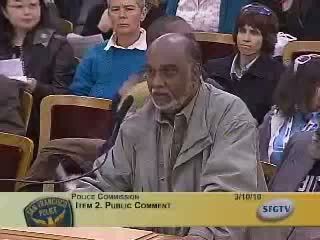
Public comment stretched more than an hour. Speakers from neighborhood councils, business districts and homeless‑advocacy organizations voiced a wide split: some said the city needs an effective enforcement tool to protect customers, visitors and merchants; others said existing laws can and should be enforced and that criminal penalties will punish poverty and impose fines or jail time on people who cannot pay.
Next steps: the item was discussion only; the commission did not vote on the draft ordinance. Commissioners repeatedly urged the Board of Supervisors and the department to narrow the draft language, publish supporting statistics, and produce clear general‑order guidance defining when officers should and should not cite. The department said it would continue to engage the community and the city attorney’s office and that the Board of Supervisors ultimately controls whether an ordinance is adopted.