Get Full Government Meeting Transcripts, Videos, & Alerts Forever!
Get email alerts on the Policing Use Of Force topic
No spam. Unsubscribe anytime.
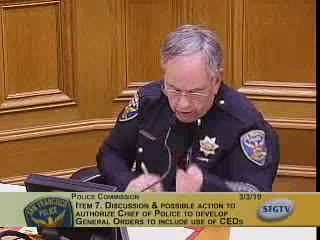
Police commission rejects motion to let chief draft taser policy after long public hearing
Summary
After hours of expert testimony, legal arguments and heated public comment, the San Francisco Police Commission voted 4–3 on March 3, 2010, against a motion that would have authorized the chief to develop revisions to department general orders to include conducted energy devices (tasers). The decision leaves any future policy change subject to further study and community engagement.
The San Francisco Police Commission voted 4–3 on March 3 against a motion that would have authorized the police chief to draft changes to Department General Order 5.01 (use of force) and DGO 10.02 (equipment) to include conducted energy devices (tasers) and to develop related policy, training and implementation plans.
The item drew six hours of presentations, expert testimony and public comment. Two physicians who described an observational study of taser introduction in California urged caution, saying their data showed a statistically significant rise in sudden deaths in the first full year after agencies adopted tasers. “We found a sixfold increase in sudden deaths in the first full year after tasers were implemented,” one presenter said, while acknowledging the limits of observational data and that the study could not prove causation. The doctors recommended avoiding chest shots, minimizing the number and duration of cycles, and equipping vehicles with automatic external defibrillators (AEDs).
Lawyers and advocates pressing the commission to delay action pointed to litigation and reporting gaps. John C. Burton, a plaintiff’s attorney who has litigated against the manufacturer, said the company’s historical testing and training raised concerns and urged the commission not to approve broad adoption until independent standards and oversight were in place. “Until those standards are developed,” Burton said, “departments are relying on training and representations from the manufacturer, which has a built‑in conflict of interest.”
Civil‑rights and community groups argued for broad public engagement and incremental pilots before adding tasers to department policy. Kelly Evans of the ACLU of Northern California recommended a community‑driven process that includes mental‑health experts, independent monitoring and a tightly constrained pilot if the department proceeds. “These weapons are not nonlethal, and they are not harmless,” Evans told the commission.
Police officers and union representatives who testified supported exploring tasers as an intermediate option that could prevent shootings and reduce injuries in some encounters. Several uniformed officers described field situations in which an intermediate force option could have prevented deadly outcomes or serious officer injury.
Commissioners pressed both sides on the evidence and the process. Supporters of the motion emphasized prior recommendations from outside reviewers and the chief’s intent to develop a strict, supervised rollout; opponents cited uncertain science, unregulated device specifications and cost and oversight gaps. Commissioners also raised the need to improve mental‑health crisis response and officer training before considering broad deployment.
On the roll call the motion failed: Commissioners De Jesus, Hammer, Lee and Pan voted no; Commissioners Marshall, Mazuko and Onick voted yes. Because the motion did not pass, the commission did not formally authorize the chief to place tasers in the department’s use‑of‑force or equipment orders. Any further change would require future action by the commission following additional proposals, community engagement and rule drafting.
What happens next: with the motion defeated, the chief may still convene stakeholders informally and the commission can request or receive any draft general order in the future; however, no policy change was authorized by the March 3 vote. Commissioners and several witnesses said the issue is likely to return only after more exhaustive review of medical evidence, independent device verification, tighter reporting and accountability measures and expanded mental‑health training for officers.
The hearing record includes repeated calls for precise monitoring and reporting of any future taser deployments, tighter limits on when the devices may be used, and clear oversight by the Office of Citizen Complaints and the commission. Cost estimates and logistics were discussed but not finalized; witnesses noted per‑unit prices and replacement cartridge costs but cost projections for a fully deployed program remained “not specified.”