Get Full Government Meeting Transcripts, Videos, & Alerts Forever!
Get email alerts on the Internal Accountability topic
No spam. Unsubscribe anytime.
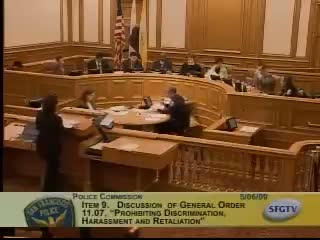
Police Commission Reviews New Early Intervention Reports; AIM Automation Timetable Set
Summary
The commission reviewed the first-quarter Early Intervention System report: an interim manual system flagged 76 members (about 3% of the department) who met thresholds and the department gave an AIM automation timeline with pilot training in late June/early July and a target project completion in February.
The Police Commission received an update on the department—s Early Intervention System (EIS) and progress on the AIM (Administrative Investigative Management) automation effort.
Lieutenant Brown described the interim EIS, a monthly report that aggregates ten officer "indicators" (use of force, officer-involved shootings, OCC complaints, EEO complaints, civil suits, tort claims, on-duty accidents, vehicle pursuits and others) and associated factors used to contextualize alerts. As of the latest report, 76 members had met or exceeded thresholds (about 3% of the department); 53% of members had zero indicator points.
Brown said staff are operating an interim, paper-based system while developers build AIM. AIM requires data conversion across nine legacy indicator databases; the department reported completion of milestones 1-5 and concurrent work on milestones 6-8. A training week for indicator units and a pilot station was scheduled for the week of June 22, with a target for indicator units to be online by July 6 and a target to complete the full project by February (date given at presentation).
Commissioners and union representatives asked about the meaning of indicator counts for busy stations (some stations with heavier workloads may accumulate more indicator points), the role of associated factors in peer analysis, and whether specific associated factors (for example, assaults on officers or resisting arrest) should count toward thresholds. The San Francisco Police Officers Association representative said he was concerned that some associated factors reflect circumstances beyond officers' control and requested continued participation in refining the system.
Lieutenant Brown told the commission the automated AIM system will provide one-way feeds from units such as OCC and that officers will be able to view their own records in AIM to verify and correct errors. The department said it will provide quarterly reports and expects to present more outcome data on interventions and retraining after AIM is operational and monthly performance-review tracking is established.
The commission asked staff to provide subsequent reports showing interventions, outcomes, and peer-adjusted analyses once AIM is online.