Get Full Government Meeting Transcripts, Videos, & Alerts Forever!
Get email alerts on the Solar Incentives topic
No spam. Unsubscribe anytime.
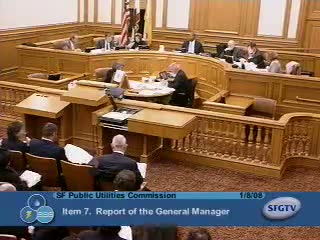
SFPUC backs plan to pilot $3 million solar incentive, commissioners set implementation details
Summary
The San Francisco Public Utilities Commission reviewed a staff proposal to use $3 million from MECA-designated power funds to launch a one-year solar incentive pilot offering $3,000–$5,000 for homeowners and up to $10,000 for businesses, with bonuses for local installers and environmental-justice neighborhoods; the commission heard extensive public support and invoked procedural steps to vote despite potential conflicts.
The San Francisco Public Utilities Commission on Thursday reviewed a staff proposal to fund a municipal solar-incentive pilot using a $3,000,000 balance of MECA-appropriated power funds and asked the general manager to finalize eligibility rules.
Assistant General Manager for Power Barbara Hale presented the proposal, saying it would “use HECE power net operating revenues to fund a solar energy incentive payment” available to all San Francisco residential and business property owners for systems 1 kilowatt or larger. Residential incentives would run from $3,000 (base) up to $5,000 for owners who use a San Francisco installer or who are located in designated environmental-justice ZIP codes, while business customers would receive $1,500 per kilowatt up to a $10,000 cap, Hale said.
The program is paired with a Board of Supervisors ordinance and a proposed solar loan program; Hale told commissioners the earliest the PUC would begin accepting applications is after the Board adopts the ordinance, expected in early to mid-February. She said the PUC anticipates using a first-come, first-served allocation for the initial $3 million, with roughly $150,000 budgeted for administration and outreach.
Assessor Phil Ting, a lead on the city's Solar Task Force, urged commissioners to back the program and outlined its potential: “If you were able to do $3,000,000 in year 1 of incentives, you could potentially do almost 1,000 single family homes,” Ting said, projecting that the pilot could double San Francisco's solar rooftops if scaled. He and other speakers emphasized local job creation through a local-installer bonus and cited the program as one piece of a broader strategy to reduce demand for new combustion power plants.
Dozens of public commenters, including neighborhood groups, installers and industry representatives, voiced support. Linden Rive, the chief executive of SolarCity, said the program's simplicity and local incentives would help create a local training pipeline and make installations economically feasible in San Francisco, where per-watt costs are higher than surrounding communities.
Commissioners asked technical and implementation questions: whether the program would be retroactive to installations after the December 14 announcement (Hale said eligible systems installed since that announcement would be included), how to prioritize applications if demand exceeds the allocation (Hale reiterated year-one first-come, first-served), and whether the city's incentive would stack with state and federal incentives (Hale said it would not disqualify applicants from other rebates or federal tax credits).
Because several commissioners are homeowners and could be eligible for the incentive, the deputy city attorney advised invoking the legal "rule of necessity" so a randomly selected quorum could lawfully vote on the matter; the commission moved forward with that procedure for later action. The Board of Supervisors' ordinance and the PUC's final program rules remain the next procedural steps.
The commission did not finalize program rules at this meeting; staff was directed to return with implementation criteria for the general manager to administer once the Board adopts the enabling ordinance.