Get Full Government Meeting Transcripts, Videos, & Alerts Forever!
Get email alerts on the Electric Reliability Project topic
No spam. Unsubscribe anytime.
SFPUC delays vote on Potrero combustion turbines after air-quality briefing and heavy public opposition
Summary
The San Francisco Public Utilities Commission continued its decision on a proposed in-city combustion-turbine project after a Bay Area Air Quality Management District briefing showed emissions trade-offs and hundreds of residents raised health and environmental-justice concerns; commissioners requested more data and scheduled further workshops and community meetings.
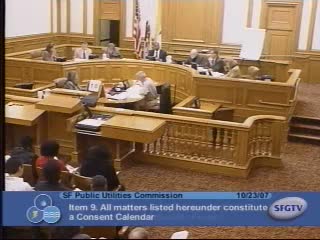
The San Francisco Public Utilities Commission on Oct. 6 continued consideration of a proposed in-city combustion-turbine (CT) project intended to meet local reliability needs, saying staff and outside agencies must provide clearer guarantees about emissions, operating limits and financial terms before the commission will take a vote. The commission also committed to additional workshops and a community meeting in Potrero Hill on Nov. 13.
The commission opened the discussion by reading the staff item tied to SFPUC Resolution 070137 and saying the contract paperwork was not yet complete; the chair said item 10 would be continued but that public comment would be heard. Commissioners then heard a technical briefing from the Bay Area Air Quality Management District (BAAQMD) and an extended public-comment period in which residents of Bayview-Hunters Point, Potrero Hill and Dogpatch urged rejection of new CTs.
The BAAQMD’s Air Quality Engineering Manager, Barry Young, told the commission that nitrogen oxides (NOx) — which react with sunlight to form ground-level ozone and contribute to particulate formation — are the primary regional concern. Young explained that Moran Unit 3, a gas-fired unit, provides about 97% of the plant’s energy and that in 2005 the unit received a selective catalytic reduction (SCR) retrofit that cut NOx emissions by roughly 90 percent. By contrast, the facility’s three diesel peakers account for a disproportionate share of NOx despite producing only a small share of total output. Young also noted a BAAQMD gas-turbine rule amendment that sets a 42 parts-per-million NOx limit for non-gaseous-fired turbines; the regulation’s compliance schedule was cited with an effective date near Jan. 1, 2010, meaning many older diesel turbines would need retrofit or retirement to meet the limit.
Commissioners pressed BAAQMD and staff on how reliability obligations from the California Independent System Operator (Cal ISO) interact with air- and water-quality rules. Barbara Hale, assistant general manager for Power, described earlier cases where Cal ISO’s Reliability Must Run (RMR) contracts compensated operators for costs associated with meeting reliability requirements while the Air District and regional water board imposed environmental requirements.
Commissioner David L. Normandy (first-raised concerns recorded on the public record) and others asked four core questions the commission wants answered before taking action: whether Moran (the baseload unit) will be closed once new CTs are installed; whether contracts (including any J-Power or airport-related agreements) allow merchant operations beyond the city’s peaking needs; what the full financial burden to the city will be (including lifecycle and decommissioning costs); and whether the proposed technology is the best available option or obsolete compared with modern alternatives.
Hundreds of minutes of public comment followed. Residents and community groups including the Mothers Committee, the Closer Coalition and the Closing Coalition told commissioners they oppose siting new CTs near residential neighborhoods and urged the commission to prioritize people and health over commercial arrangements. Representative remarks included: “We don’t need power. We don’t need a power plant” and appeals to invest in solar and load-reduction alternatives rather than new fossil-fuel peakers. Several speakers asked that community meetings be held locally to broaden participation and to ensure working residents can attend.
The commission did not vote on item 10. Instead, commissioners directed staff to provide clearer, categorical answers to the four core questions; to coordinate with the mayor’s office and Cal ISO on financial and reliability implications; and to schedule a detailed workshop focused on risk-assessment mitigation measures, budget impacts and scope changes. The commission also accepted the BAAQMD’s offer to provide updated emissions spreadsheets that allow the staff to model different annual-hours scenarios for the CTs.
Next steps: the commission scheduled further workshops and a community meeting on Nov. 13; staff said they will return with financial analyses, legal limits on operation, and refined emissions modeling before the commission votes.