Get Full Government Meeting Transcripts, Videos, & Alerts Forever!
Get email alerts on the WESIP Risk Mitigation topic
No spam. Unsubscribe anytime.
SFPUC outlines WESIP risk-mitigation plan; commissioners press for clearer PEIR and budget scenarios
Summary
SFPUC staff presented a WESIP (Water Enterprise Capital Improvement Program) risk mitigation action plan identifying top program risks—contracting challenges, PEIR certification and required shutdowns—and proposed measures including contractor prequalification, web invoicing, environmental RFQs and public outreach. Commissioners requested worst-case/best-case budget scenarios for the next workshop.
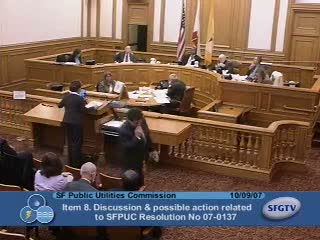
In a workshop presentation, Julie Labonte, WESIP director, reviewed a risk mitigation action plan based on the Parsons/CH2M Hill assessment and outlined steps the San Francisco Public Utilities Commission staff will take to reduce schedule and cost risk across the Water Enterprise Capital Improvement Program (WESIP).
Why it matters: WESIP is a multibillion-dollar infrastructure program that requires coordinated contracting, environmental review and extensive system shutdown work. The commission must balance schedule, budget and community impacts while maintaining service reliability.
Presentation highlights: Labonte said the PEIR (program environmental impact report) totals more than 3,000 pages and that the program’s top risks are contracting challenges, timely PEIR certification and the shutdowns required to complete work. Proposed mitigation steps include expanding contractor prequalification, launching a web-based invoicing and payment process to speed contractor payments, issuing RFQs for as-needed environmental services to expedite PEIR responses, appointing a shutdowns manager, and developing a public outreach program to keep impacted communities informed.
Commissioner questions: Commissioners pressed staff for clarity about whether the PEIR was on the program’s critical path and requested three budget scenarios—"worst, best and most likely"—along with confidence levels for each. Commissioners also asked staff to present a matrix identifying the most critical projects to protect if budget constraints require cuts.
Public and stakeholder input: Speakers from environmental and river-protection groups urged the commission to separate seismic upgrades from any additional water diversions from the Tuolumne River; staff said it would consider bifurcating projects to expedite seismic work while addressing diversion questions later. Peter Dreckmire (Tuolumne River Trust) emphasized concern for Chinook salmon and steelhead flows.
Next steps: Labonte said a third workshop will present revised schedules and budget forecasts and will give commissioners the materials needed to make decisions about program scope or project prioritization. Staff committed to provide a clearer schedule and budget options and to make materials available in advance.
Attribution: "Our goal is to produce complete and technically sound analysis of environmental impacts," Julie Labonte said. Commissioner Scar asked for consistent public messaging on whether the PEIR is on the critical path, and Labonte agreed to clarify that in follow-up materials.
Ending: The commission scheduled follow-up workshops to review schedule deltas, budget forecasts and contingency options; no votes were taken on program budget changes at this session.