Get Full Government Meeting Transcripts, Videos, & Alerts Forever!
Get email alerts on the Transportation Enforcement topic
No spam. Unsubscribe anytime.
SFMTA to Assume "Spot" Enforcement After Commissioners Hear Yearslong Contractor Complaints
Summary
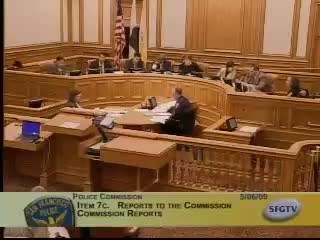
The Police Commission heard a full briefing on the Safe Path/Spot program and on SFMTA plans to take full responsibility July 1; commissioners pressed MTA and SFPD on citation practices, whether the enforcement was applied evenly, and due-process questions about 194.3 citations.
The San Francisco Police Commission on May 2009 heard a prolonged presentation and public testimony about the city—s Safe Path/Spot enforcement program and was told the San Francisco Municipal Transportation Agency (SFMTA) will take full operational control on July 1, with proposed code changes to make the first three violations infractions rather than misdemeanors.
SFMTA—s parking-and-traffic director Ban Yee introduced Brian Dusso of SFMTA—s Spot program, who traced the program—s evolution from a pilot in 2004 to a broader enforcement effort and described the agency—s goals as education, enforcement and engineering. Dusso said the SFMTA will manage revenues, provide engineering and training, and that SFPD will provide enforcement support when needed. He described a move to better documentation (photos and officer narratives) and to a TransLink card swipe system to show when officers ride Muni lines as part of inspection duties.
Commissioners and dozens of public speakers pressed SFMTA and SFPD officials on several recurring concerns: the high citation counts in prior years (contractor citations numbered in the thousands in 2007), complaints that contractors were cited far more often than utilities or city agencies, assertions that hearings sometimes lacked due process, and the perception that the program generated revenue that paid for overtime enforcement.
"We want to ensure that all users of the public right of way are able to do so in a safe and reasonable manner," Dusso said in the presentation. He defended the accuracy of citation counts and said the program has increased admonishments (warnings) and improved compliance on many sites. He added that SFMTA will propose code changes so that the first three violations are treated as infractions and only repeat or serious breaches would be misdemeanors.
Contractors and industry representatives told the commission they had seen ticketing practices they considered uneven and, in some cases, heavy-handed. One contractor representative said operators sometimes found it difficult to get police reports or supporting documentation before appeal hearings, complicating defense preparation. Commissioners repeatedly asked MTA and SFPD to supply underlying reports and payroll/revenue data for 2007—s 1,755 citations and related overtime payments so the commission could evaluate whether the program created perverse incentives.
SFPD and SFMTA officials acknowledged that earlier processes were imperfect and outlined remedies already under way: hearings previously handled informally by phone have shifted to in-person adjudications at 1 South Van Ness; the program decentralized enforcement to district stations in 2008 so officers generally enforce only in their own districts; and SFMTA proposed using senior street inspectors as primary enforcers with uniformed backup when necessary.
Commissioners pressed a number of legal and procedural questions the city attorney will need to clarify, including whether 1) 194.3 citations should be treated as misdemeanors or infractions for purposes of discovery and trial rights, and 2) contractors should routinely receive the police report prior to an appeal. Commissioner Mizuho noted that if certain citations are misdemeanors, respondents may be entitled to discovery, counsel and a jury trial.
Commissioners asked staff to return with more specific data: a breakdown of citations by contractor vs. utility vs. public agency, the revenue generated by citations in the years with the highest counts, how much of that funded SFPD overtime, and the police payroll paid by the program. SFMTA officials agreed to provide available records and to continue collaborative meetings with industry representatives.
Next steps: SFMTA—s takeover is planned for July 1; the agency will propose transportation-code edits to reclassify initial violations as infractions and will pilot the TransLink-based tracking and senior-street-inspector enforcement model. Commissioners requested a written report back in the coming weeks with the financial breakdown for 2007 and a status update on whether the procedural fixes (in-person hearings, documentation and TransLink tracking) have been fully implemented.