Get Full Government Meeting Transcripts, Videos, & Alerts Forever!
Get email alerts on the Transbay Cable topic
No spam. Unsubscribe anytime.
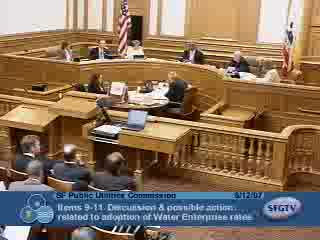
SFPUC backs Transbay Cable with amendments after hours of public comment and debate
Summary
After an extended presentation, heavy public comment and commissioner debate, the San Francisco Public Utilities Commission on June 7 approved a policy resolution on the Transbay Cable project with amendments adding community mitigation language, outreach requirements and a footnote clarifying CAISO technical conclusions.
The San Francisco Public Utilities Commission on June 7 approved a resolution outlining the commission’s conclusions and recommendations about the Transbay Cable transmission project, adding amendments to require community outreach, allow use of settlement funds for community mitigation, and to note California Independent System Operator (CAISO) findings as CAISO opinions rather than SFPUC endorsements.
SFPUC staff member Barbara Hale described the Transbay Cable project as a 400-megawatt, 57-mile direct-current transmission line with converter stations at both ends and estimated the project cost at about $450 million. Hale said the cost would be allocated among California ISO users and would add roughly $0.22 a month to an average San Francisco residential bill.
Commissioners and staff debated whether demand response, energy efficiency and other transmission alternatives could defer the need for the project. Staff said those alternatives exist but are less mature—lacking full CEQA clearance, permitting or financing—while CAISO’s 1-in-10-year reliability criteria supported the project as a solution to certain transmission-outage scenarios.
Public comment filled the chamber for the Transbay item. Speakers from Bayview-Hunters Point, Potrero Hill and other neighborhoods urged stronger community outreach, clearer explanation of how the project would affect local neighborhoods and that project payments (cited at roughly $20–25 million) be used directly for community benefit and mitigation. Espinola Jackson of Bayview said, "No way to the CTs in my community," expressing opposition to combustion turbines being sited in the neighborhood and urging protections as the city considers changes to in-city generation.
Project proponents and construction-trade representatives said the project would improve reliability, create union jobs and that sponsors had conducted outreach; the project's lead representative, David Parquet of Babcock & Brown/Transbay Cable, listed mailings, hearings and planned community outreach materials.
Commissioners offered and accepted staff- and attorney-drafted amendments: add language that funds received may be used to promote renewable energy and efficiency projects or for mitigation within affected communities; ask the project sponsor to develop outreach plans with SFPUC external affairs; and include an asterisk indicating CAISO conclusions are CAISO opinions (not formal SFPUC policy positions). Chair Brooks moved adoption of the resolution with amendments; the commission voted to adopt the measure.
The commission directed staff to prepare a final report for Supervisor Sophie Maxwell and the Board of Supervisors while continuing stakeholder discussions on demand-response and efficiency options.