Get Full Government Meeting Transcripts, Videos, & Alerts Forever!
Get email alerts on the Water Rates topic
No spam. Unsubscribe anytime.
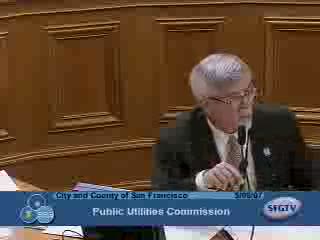
SFPUC approves new tiered water rates and capacity charge framework after hours of public comment
Summary
After more than two hours of public testimony, the San Francisco Public Utilities Commission approved inclining block water rates for single-family customers, a modest increase to the water capacity charge and related schedules intended to fund seismic and system work while staff pursues outreach and potential equity adjustments.
The San Francisco Public Utilities Commission on Tuesday approved new schedules of water rates and a related capacity charge that officials say are needed to fund seismic upgrades and long-term system work.
Commissioners voted to adopt the proposed inclining-block rate structure for single-family residential customers and to raise the water capacity charge (a per-connection equity buy-in) modestly, after hearing more than 70 public comments. Mr. McDonald, a senior SFPUC staff member who led the rate presentation, told commissioners the changes are designed to promote conservation and meet revenue requirements for major infrastructure projects tied to Hetch Hetchy seismic work.
Residents, landlords and small-business owners who packed the meeting argued the tiered structure would be inequitable for larger or multigenerational households and for property owners who cannot pass costs through to tenants. "It does not promote conservation since only the landlords will be paying," Marina Franco, a landlord and member of the San Francisco Apartment Association, said during public comment. Several speakers, including the Coalition for San Francisco Neighborhoods and the Residential Builders Association, urged the commission to reject or revise the structure.
Commissioners and staff spent significant time on two technical points: whether individual unit metering or submetering is feasible in older multifamily buildings, and how to treat long-term capacity fees. Mr. McDonald explained that retrofitting older buildings for unit-by-unit utility metering is often technically difficult because of shared plumbing stacks, and that the PUC has promoted submetering and allocation-based billing as partial alternatives. He said the agency’s analysis shows lot size and income correlate most strongly with higher discretionary water use, while household-size data at small geographic levels are limited.
The capacity charge—meant to capture an "equity buy-in" to past system investments—was described in the packet as a current wastewater charge of about $2,604 per equivalent dwelling unit (EDU), with staff proposing a roughly $300 increase for water capacity and an annual index adjustment and five-year recalculation. Commissioners questioned whether a single flat EDU buy-in is equitable for very small units versus very large homes and asked staff to analyze tiering options and alternative structures. "We can look at lowering the lower end and raising the higher end," one commissioner said, urging staff to return in 90 days with scenarios.
Supporters of the package said the combination of a lower monthly fixed charge and a tiered volume rate will protect low-volume users while targeting higher-volume discretionary outdoor uses. Mr. McDonald said about 20% of single-family accounts would remain solely in the lowest tier and would pay less under the proposal compared with a uniform-volume rate.
After discussion, a motion to approve the two rate items was made and seconded; the motion carried and the commission directed staff to continue outreach, provide additional equity analyses and work with the Rent Board and Board of Supervisors on pass-through and submetering policy issues where those bodies have jurisdiction. The staff presentation and the public record showed: proposed effective meter-reading dates of July 1, 2007, and July 1, 2008; an average single-family use of about 7 CCF per month (1 CCF ≈ 748 gallons); and the existing wastewater capacity charge figure described above.
The commission also noted that some of the implementation details—particularly how to address households with multiple occupants on one meter and the mechanics of capacity-charge adjustments—require follow-up work and interagency coordination. The vote to adopt the rate schedules and capacity-charge adjustments was recorded as carried; staff and commissioners said they would return with more detailed options and outreach plans.