Get Full Government Meeting Transcripts, Videos, & Alerts Forever!
Get email alerts on the Police Practices Alcohol Policy topic
No spam. Unsubscribe anytime.
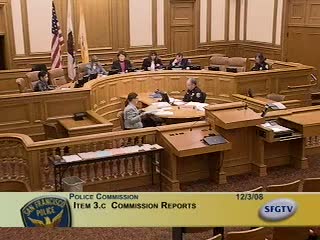
Police commission adopts tighter rules on officers’ alcohol impairment, sets 0.015 BAC threshold
Summary
The San Francisco Police Commission on Dec. 3 approved revisions to Department General Order 2.02 that set an operational blood‑alcohol reference of 0.015 (to account for test error), replaced some discretionary language with 'recommend,' and emphasized behavior-based impairment and early intervention.
The San Francisco Police Commission voted unanimously Wednesday to adopt revisions to Department General Order 2.02, the department policy governing alcohol use by members, adding a numeric threshold and clarifying procedures for off‑duty officers who carry firearms.
The commission approved amended language that sets an operational blood‑alcohol reference point of 0.015 — intended to account for a breath test margin of error — and instructs supervisors to "recommend" referral to employee assistance rather than make determinative findings when responding to off‑duty reports. President Teresa Sparks moved the measure and Commissioner Thomas Mazuko seconded; the roll call vote was Sparks—Aye, Marshall—Aye, De Jesus—Aye and Mazuko—Aye.
The policy discussion centered on balancing enforceability, medical evidence of impairment and operational needs for mass callbacks. Dr. Murphy, the department’s police physician, told the commission that "0.02 is really the earliest point that you might be able to see some effects" for some people and explained testing limitations, including a reported device accuracy margin of about ±0.005 and confounders such as mouth alcohol from recent rinses or medicinals.
Representatives of the Police Officers Association cautioned against adopting thresholds that raise the risk of false positives, saying testing and procedures must protect members from unfair discipline. "We don't wanna chance or increase the chance of false positive readings," a POA representative said during the hearing.
To address practical concerns about on‑call determinations during large events or mass callbacks, commissioners removed narrow language that would have required a supervisor to make a final "determination" over the phone; instead the amended order emphasizes an objective test when practical and allows officers who reasonably believe they may be impaired to decline to return. The commission also added operating‑vehicle restrictions and tied impairment language to both carrying a firearm and operating department vehicles.
The action follows a departmental best‑practice review of 50 local, state and federal agencies and separate consultations with medical and labor stakeholders. The commission directed staff to circulate final redline language reflecting the agreed edits and to continue coordination on implementation, testing protocol and early‑intervention measures.
The commission’s approval means the department’s general order will be updated to reflect the new numeric reference and the procedural changes approved by the vote. Commissioners said they expect additional operational guidance to accompany the order and pledged continued review to ensure the policy is enforceable and consistent with medical and legal standards.