Get Full Government Meeting Transcripts, Videos, & Alerts Forever!
Get email alerts on the Right Of Way Policy topic
No spam. Unsubscribe anytime.
Commission delays vote on revised right‑of‑way policy after neighbors and municipalities raise concerns
Summary
SFPUC staff proposed a streamlined right‑of‑way encroachment policy that would continue certain permits for 'bisected' parcels and offer limited replacement compensation; the item was continued two weeks after residents and Menlo Park, East Palo Alto and San Mateo County officials requested more time and raised implementation concerns.
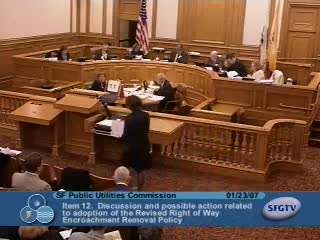
San Francisco Public Utilities Commission staff presented a revised right‑of‑way encroachment and removal policy on Jan. 23 that would replace the 1999 policy with a shorter, more user‑friendly document and new "good neighbor" measures, but the commission voted to continue the item for two weeks after substantial public comment.
Laura Fanjean (Head of External Affairs) introduced Gary Dowd (real estate) who said the updated policy aims to clarify procedures for three categories of encroachments: bisected parcels (where the PUC owns fee interest that cuts through a private lot), municipal uses (parks, playgrounds, etc.) and neighborhood association landscaping. Staff said the revised policy preserves existing allowances for bisected parcels, proposes permit continuity and suggested that in the event a PUC project removes a driveway or walkway the PUC would pay to replace those specific improvements at standard cost, while fencing replacement would remain the property owner's responsibility.
Gary Dowd said staff calculated about 290 encroachments in the Bay Division pipeline area under review (BDPL5), of which roughly 40 are bisected parcels. He described a proposed process of certified appraisals and reimbursements for certain in‑place improvements and said existing permit language contains indemnification clauses for permittees.
Municipal representatives and dozens of residents from North Fair Oaks, Menlo Park, East Palo Alto and adjacent unincorporated areas urged more time to review the draft and clarifications on key terms. Concerns cited by speakers included: timing and adequacy of notice to affected homeowners, definition and legal characterization of "bisected parcel," whether the PUC would restore streets, sidewalks and landscaping "in kind," and the public‑safety and erosion control implications of leaving long stretches of disturbed ground after construction.
Ken Steffens (Menlo Park) and written comments from Menlo Park requested explicit commitment to replace public infrastructure in kind and more time to review existing right‑of‑way agreements. Patricia Byers (North Fair Oaks resident) asked that the policy language be corrected so long‑standing fenced yards would remain eligible for the proposed bisected‑parcel treatment. Other municipal representatives asked that the PUC produce existing agreements for review.
Commissioners noted the policy goes beyond legal obligations by offering reimbursements and emphasized the need to set minimum landscaping standards that protect PUC property and water quality. They requested staff work with the city attorney on mediation language and fair‑value processes for replacement costs.
After discussion Commissioner Normady moved to continue the right‑of‑way item for two weeks to give staff time to consult with the affected cities and counties and to refine language on cost allocation and mediation; the motion carried.