Get Full Government Meeting Transcripts, Videos, & Alerts Forever!
Get email alerts on the Stormwater Management topic
No spam. Unsubscribe anytime.
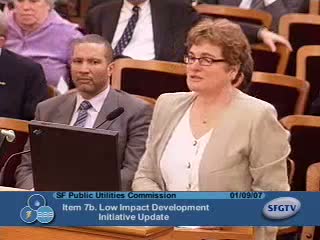
PUC staff lays out low-impact development plan to reduce stormwater loads and augment sewers
Summary
Wastewater staff presented a Sewer System Master Plan approach that uses low-impact development (LID) — bioswales, cisterns, eco-roofs and other green infrastructure — to reduce local sewer flows; early demos show 15–30% local reductions, but citywide impacts are still being modeled and funding/maintenance issues remain.
Arlene Navarette, regulatory manager for the Wastewater Enterprise, presented the San Francisco PUC’s approach to integrating low-impact development (LID) into the Sewer System Master Plan, describing LID as green infrastructure that captures and treats surface flows upstream of combined sewers.
Navarette said LID — also called best management practices or green infrastructure — can intercept runoff, reduce the volume of combined sewer discharges and provide local environmental benefits. She described demonstration projects such as a Sunset Circle parking-lot retrofit that uses swales, native vegetation and an infiltration basin to collect most rain events and reduce pollutant runoff to Lake Merced.
“Where current pipes contain the five- or ten-year storm event, LID implementation may make the system capable of containing the 15-, 25- or even 50-year event,” Navarette said, while cautioning that citywide benefits depend on site-specific conditions and additional modeling.
Staff reported preliminary local analyses that indicate reductions in flows to the sewers in the 15–30% range for some demonstration areas; Navarette and commissioners emphasized that those figures are local estimates and do not yet represent a citywide reduction number. Navarette said ongoing modeling will assess impacts down to smaller sewers and across eight drainage basins, and consultants will identify low-impact opportunities in each basin.
Commissioners raised implementation questions: where permeable surfacing is appropriate, how LID would interact with existing maintenance regimes, what the long-term maintenance costs would be and how agencies such as DPW, Recreation & Park and the Planning Department would coordinate. Navarette said some permeable surfacing is being explored but is not suitable for all locations (heavy-load streets, bedrock areas, contamination or liquefaction risks), and that DPW and other agencies are partners in demonstration projects.
Several commissioners urged staff to pursue “targets of opportunity” — short-term demonstration projects the commission could fund in the upcoming budget cycle rather than waiting for the full master plan. Navarette said staff will include economic analyses, design standards, and funding strategies in the master plan rollout and will return with more detailed modeling and cost estimates in coming months.
The commission did not take an action on LID at the meeting. Staff said program-level funding and detailed implementation strategies will be brought back for commission review as modeling, design standards and pilot results become available.